Magic, the Aether and the Veil
Where power comes from, where souls come from, and the pocket of the world the fae built.
This page is the shared background the species entries lean on. It exists so each entry can say what a species does with magic without re-explaining the system underneath it every time.
At a glance
The Aether — Predates everything here; every soul is drawn from it.
Wild magic — Raw magic older than the pure magics; a force of nature, and nobody’s to wield.
The Veil — A magical pocket over this plane, made by the fae, mainly holding Earth-born species.
Pure magics — Light, dark, chaos and order — the four that made everything else.
Fundamental forces — Elemental, spiritual, physical and mental; created by the pure magics, but no longer lesser than them.
Extra forces — Rule-breaking magics that fell out of the interplay of the others.
Holding more than one — Possible — for pure magics and for affinities alike.
The Aether
The Aether predates the Veil and predates most of what is described here.
Every soul is drawn from it. That holds regardless of where a species comes from — a shade born of shadow, an aetherforged whose soul was deliberately pulled out of the Aether and bound into metal, and anyone born anywhere else all have souls from the same source.
The Veil
The Veil is a magical pocket laid over this plane. The fae built it, and it is where most fae are born.
It was made to hold the magical species born on Earth, and that is mostly who lives in it. It did not stay the size it was built, though — it expanded on its own, and when new levels opened up, demons moved into one of them. Tieflings live there now, as do jorōgumo and the other Earth-born magical species.
Time inside runs unevenly. The deeper in you go, the faster it moves, so someone who travels deep and returns finds more time has passed outside than they lived through. How much depends entirely on how deep they went.
The Veil is not a prison and not a wall. Anyone can enter or leave at a crossing. Those who live there are not confined to it, and those who live outside it are not shut out.
Everything not in the Veil is still on this plane. Species with homeworlds of their own — feliry, luperin, tokren, syntheon, vulperin — are simply elsewhere in it, on other worlds or out in space.
Wild magic
Wild magic is magic before anything was done to it. It is older than the pure magics, and the pure magics came out of it.
It cannot be wielded. That is not a matter of difficulty or of nobody having managed it yet — there is nothing there to wield. Wild magic is a force of nature without thought behind it, and it no more takes direction than weather does.
It and the aether are of the same age, and the two are entwined with one another. Neither made the other, and neither is the elder.
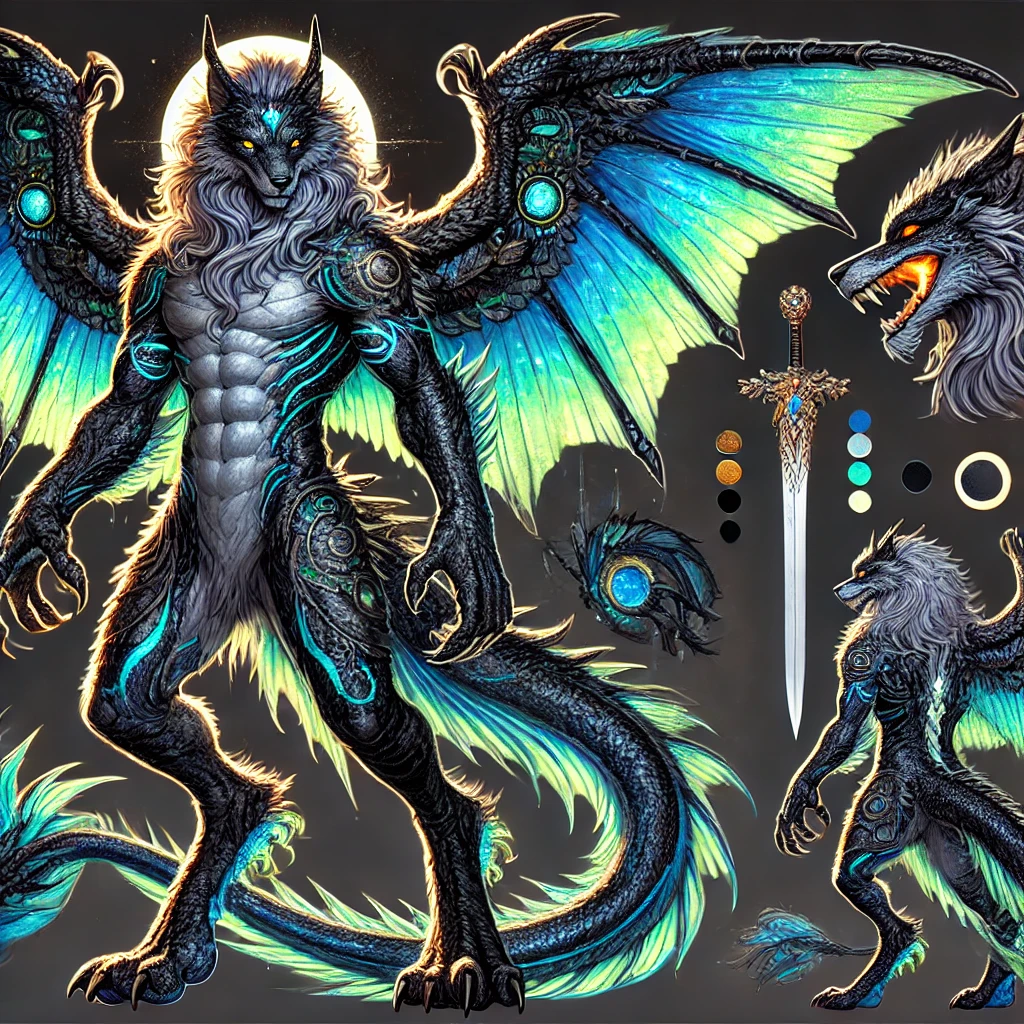
Where wild magic is visible in this guide is in the forms — every one of them is a mutation it produced. It also appears to have settled on the mantheryn as a whole, and is the likeliest reason every one of them survives open space unaided.
The pure magics
There are four: light, dark, chaos and order. They are the oldest magics here, and they are what created the fundamental forces — though being older does not make them stronger, and has not for a very long time.
Each is defined by where its power comes from, not by what it can do.
Light
Light magic draws its power from the elements around the wielder, or from an artifact imbued for the purpose.
Because a light wielder is never spending themselves, they do not run out. Their exhaustion comes from exertion — they tire the way anyone tires from hard work.
Dark
Dark magic draws its energy directly from the wielder, or from a sacrificial object such as a bone or a piece of tissue.
The cost is paid rather than gathered. Dark is not a synonym for evil; it describes a power source and nothing more.
Every demon carries it.
Chaos
Chaos magic draws on the wielder’s mental strength. The more determined they are, the stronger it is.
Concentration is irrelevant to it, and in some cases actively makes a chaos wielder weaker. It is very rare.
Order
Order magic draws on the wielder’s concentration. The more closely focused on the task they are, the more likely it is to succeed.
Sheer force of will does nothing for it, and trying to force order magic typically fails outright. It is also very rare.
Chaos and order are usually gained later in life, and they attach to an individual rather than to a species or a bloodline — though a handful of exceptional cases have run in bloodlines.
The fundamental forces
The fundamental forces were created by the pure magics. They are thought of as separate forces now because they are — and they have not been the lesser of the two for a very long time. Descent says where they came from, not what they are worth against each other.
They fall into four groups.
Elemental
Fire, water, earth, and storm — storm covering wind and electricity together.
Spiritual
Soul, spirit and vital.
Soul is what defines someone as alive, and what they are naturally inclined toward. It is also why soul magic can be used to control a person, though that is much harder than the alternatives.
Spirit is a person’s growing self-energy — everything they build on top of the soul. It is not the weaker of the two for being built rather than given; its strength depends on the individual, and it grows stronger and better defined over time.
Vital is the energy of life itself. Healers carry it often. It is rare and highly sought after.
Physical
Kinetic and body.
Kinetic governs kinetic energy, and is the equivalent of telekinesis.
Body covers speed, strength, endurance, density and healing.
Mental
Will, time, thought and emotion.
Will is what allows mental enslavement, though the same thing can be done consensually through a spell.
Time covers speed and foresight.
Thought is the equivalent of telepathy.
Emotion is the equivalent of empathy.
Extra forces
An extra force is a magic that fell out of the interplay of other magics. Their origins tend to be difficult to trace, and they tend to break the rules the rest of the system follows.
Several of the things described elsewhere in this guide are extra forces rather than fundamental ones.
Hellfire, carried by some demons and not others, for reasons nobody knows — every tiefling and every hellhound among them. It burns materials that are not flammable and burns through magical wards, and it forges artifacts that very little can break. Anyone who carries it cannot be burned.
Shadow magic, which every shade uses implicitly.
Star-essence, sun-and-moon, and the void — the three marking powers of the vulperin.
Kitsune shapeshifting and soul-stealing, which is the original kitsune magic and sits apart from the light and dark they inherited later.
Gumiho shifting and taking, which carries a gumiho between shapes and lets them keep the shape and abilities of a creature they have eaten. Like the kitsune force it stands outside the ordinary structure of magic, and the two are not the same force.
The sorberanth absorption, which takes a creature swallowed whole and alive and adds its magic, its soul and part of its biology to the sorberanth permanently. It sits near the gumiho taking and works differently: a gumiho comes away with a shape they can wear, and a sorberanth comes away with parts built into the one body they keep for life.
Wyvern venom, whose elemental character runs through biology rather than through an ordinary affinity — which is part of why the wyvern elemental bloodlines are breeds.
Phoenix fire, which purifies and heals poison as readily as it burns. That is not something elemental fire does, and it is why phoenix fire is not simply the fundamental force under another name.
Gargoyle stone, meaning a gargoyle’s control over their own substance. Their stone is far stronger than ordinary stone and deflects many kinds of magic, which a material should not be able to do.
Metallurgist metal control, carried by the Metallurgist dragon breed and distinct from the fundamental elemental affinity other dragons carry.
Kraken ink, which alters any biological trait of whatever living thing it reaches. It runs along the ground the body affinity covers and goes well past it — body governs speed, strength, endurance, density and healing, and the ink rewrites what a creature is, species included. That is exactly the sort of overreach that puts a power in this category rather than among the affinities.
The mantheryn cocoon, made by a parent and bound to the mantheryn it was made for. It answers the needs of whoever is inside and reshapes perfectly around any being its owner permits, whatever their size, which no ordinary material or living thing manages.
Orc forging magic, which every orc carries. It flows into whatever they make and typically produces effects the orc did not choose and could not have predicted.
Magical hypnosis, described below, which turns up across several species at once.
Not everything species-fixed is an extra force, and the distinction is worth keeping straight. A dragon’s element and a gargoyle’s control over earth are both ordinary fundamental affinities — unusual only in following descent rather than belonging to the individual.
Magical hypnosis
Magical hypnosis deserves its own heading, because it is the one extra force that shows up in more than one species and stays recognisably the same thing in each.
It appears to have been born out of both thought and will together, and it is oddly consistent for an extra force — nearly all of the variation is in how it gets channelled. A kitsune puts it out as foxfire. A lamia delivers it through the gaze, and a chimera carries the gaze form too. A kraken carries it in the voice. A harpy delivers it through the gaze as well. The mechanism differs; the force does not.
Every channel depends on the sense it travels through. A gaze passes over someone who cannot see it, and a voice passes over someone who cannot hear it, and in both cases nothing arrives at all.
It grants powerful influence over a mind, and resisting it is mostly futile — only someone exceptionally strong-willed has much chance. Whatever else it is, it is unfailingly pleasant to be on the receiving end of.
The harpy version is the one place the force itself varies rather than the channel. Every other version runs while its channel runs and stops when the channel stops; a harpy’s hold outlasts the look entirely. Eye contact is how it arrives and has nothing to do with how long it stays, so a harpy can catch someone, look away and leave the room, and the hold goes with them. Two things end it: the harpy letting go, which they can do at any moment, and distance, which breaks it at roughly three miles.
Otters are the notable exception, and they prove the rule rather than break it: every otter carries the will affinity unusually strongly, and along with it a very strong resistance both to will magic and to hypnosis.
It is not the same thing as the will affinity, and the difference is practical. Will is a fundamental affinity and can genuinely be fought; it becomes overwhelming only when consent is given, at which point it stops being a fight at all. Magical hypnosis is much harder to resist from the start, and consent changes the experience far less because there was little to struggle against either way.
Affinities
An affinity is a person’s tie to one particular fundamental force.
Whether someone has one depends on both their species and themselves. Some do and some do not. Every fae does, without exception, which is why the fae entry treats it as a species trait where other entries do not.
Holding more than one
One being can hold more than one pure magic, and one being can hold more than one fundamental affinity. Neither is exclusive.
Kitsune look like an exception and are not really one. Their light and dark are tied to bloodline rather than to the individual, which is what makes a kitsune one or the other — and even there, rare halfbreeds exist.