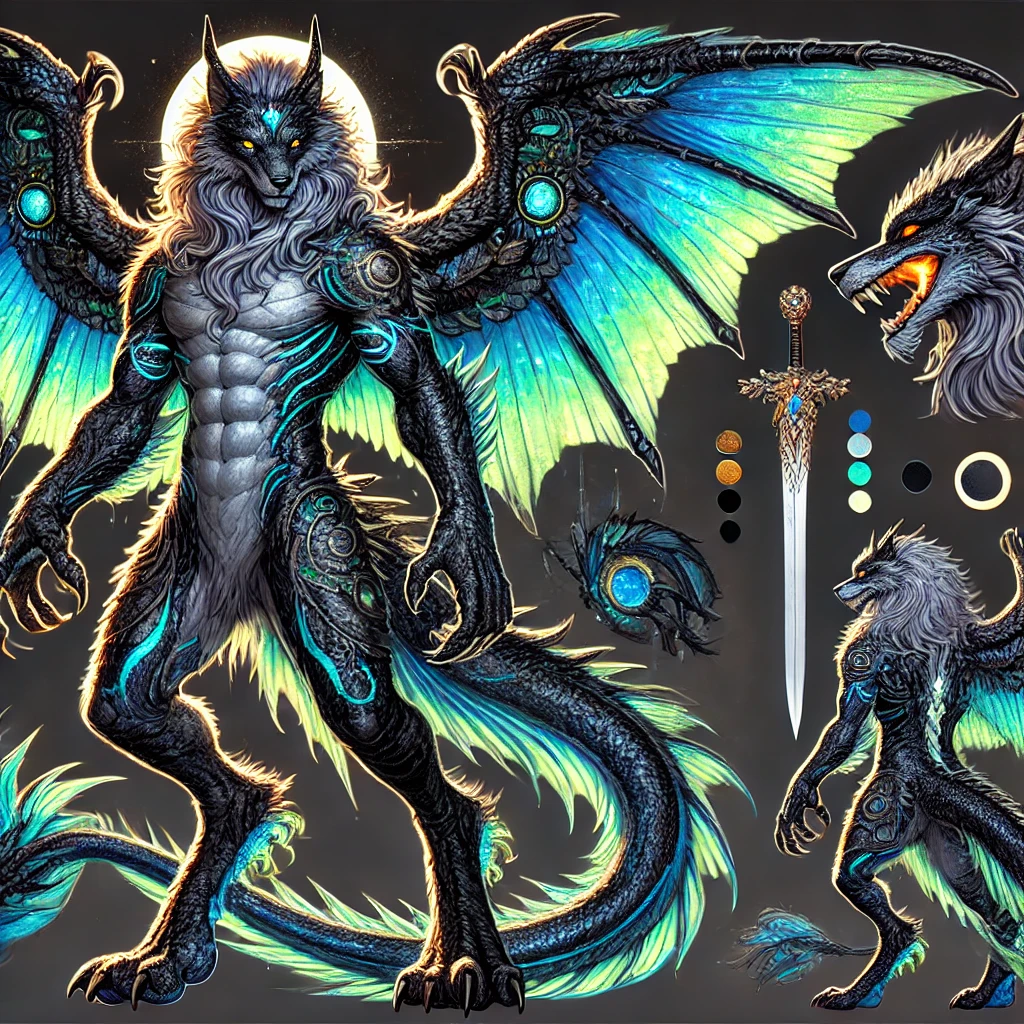
Tiefling
Demons who carry hellfire — and who forge with it as readily as they burn with it.
Overview
Tieflings are demons. In our system that word carries no verdict with it — demon is what they are, not a judgement about what they do, and tieflings shape their own paths exactly as everyone else here does.
They are born rather than made, and they eat ordinary food like anyone else.
Where they live
Demons are native to this plane. They live on a layer of the Veil — the magical pocket the fae built over this plane, which later expanded on its own. When new levels opened up, demons moved into one of them, and that is where they have been since.
Physical traits
Two things are constant. Every tiefling has a tail, and it is always fully prehensile. Every tiefling has horns, though their structure and size vary considerably from one to the next.
Skin runs across a range: midnight black, deep purples, vibrant crimson, ember orange.
There are no tiefling breeds. Variation runs on bloodline, and it is mostly cosmetic.
Magic
Every tiefling carries dark magic and hellfire as part of what they are. Dark magic comes with being a demon. Hellfire is carried by only some demons, and nobody knows why some carry it and others do not; every tiefling does, as does every hellhound. That much the species fixes. What any individual does with it does not follow from the species at all.
Tieflings also cannot be burned. The immunity is absolute and comes with the hellfire, in the same way a snow leopard cannot be frozen.
Hellfire
Hellfire is not ordinary fire and does not behave like it, and it is an extra force rather than an elemental one.
It burns materials that are not flammable, and it burns through magical wards, which is a large part of what makes it dangerous. It is also why it harms shades — hellfire burns through magic, and a shade is magic shadow incarnate.
The other half of hellfire is that it makes things.
It forges extremely strong and magically potent weapons, and armour, shields and other artifacts besides. Very few things can genuinely break something forged in hellfire. A tiefling who builds rather than burns is using the same fire either way, and Kaerazar’s work as a maker is her own bent rather than a species trait — plenty of tieflings never forge anything.
Shared instincts
Tieflings share their nature as demons, the tail, the horns, the dark magic and the hellfire. Nothing about temperament follows from any of it.
Where the name comes from
Tieflings were introduced in TSR’s Planescape Campaign Setting in 1994, designed by Zeb Cook, with the name coined by Wolfgang Baur from the German tief, “deep” or “low”. The original premise was inherited planar ancestry: a human bloodline touched somewhere back along its length by a fiend. Fourth edition standardised the now-familiar look in 2008 — swept horns, prehensile tail, unusual skin.
What we take from the source is the infernal bloodline, the demonic nature that comes with it, and the magical orientation, which for us means dark magic and hellfire specifically. We do not take the philosophy.
The classic framing — read as dangerous on sight, having to establish good faith over and over, held responsible for an ancestor’s bargain — does not exist here. That is not a stance we took against the trope. It is simply a consequence of how every one of us already sees every other creature: as their own person, shaped by their own experiences rather than by the reputation of their kind.
Field notes
Individual horn shape, colouring, bloodline and what a tiefling does with their hellfire belong on each member’s own page.
Shared traits
- Nature
- Demons; native to this plane, living on a layer of the Veil
- Magic
- Dark magic and hellfire, carried by every tiefling
- Hellfire
- Burns non-flammable material and magical wards; forges near-unbreakable artifacts
- Tail
- Always present, always fully prehensile
- Horns
- Always present; structure and size vary
- Skin
- Midnight black through deep purple, vibrant crimson and ember orange