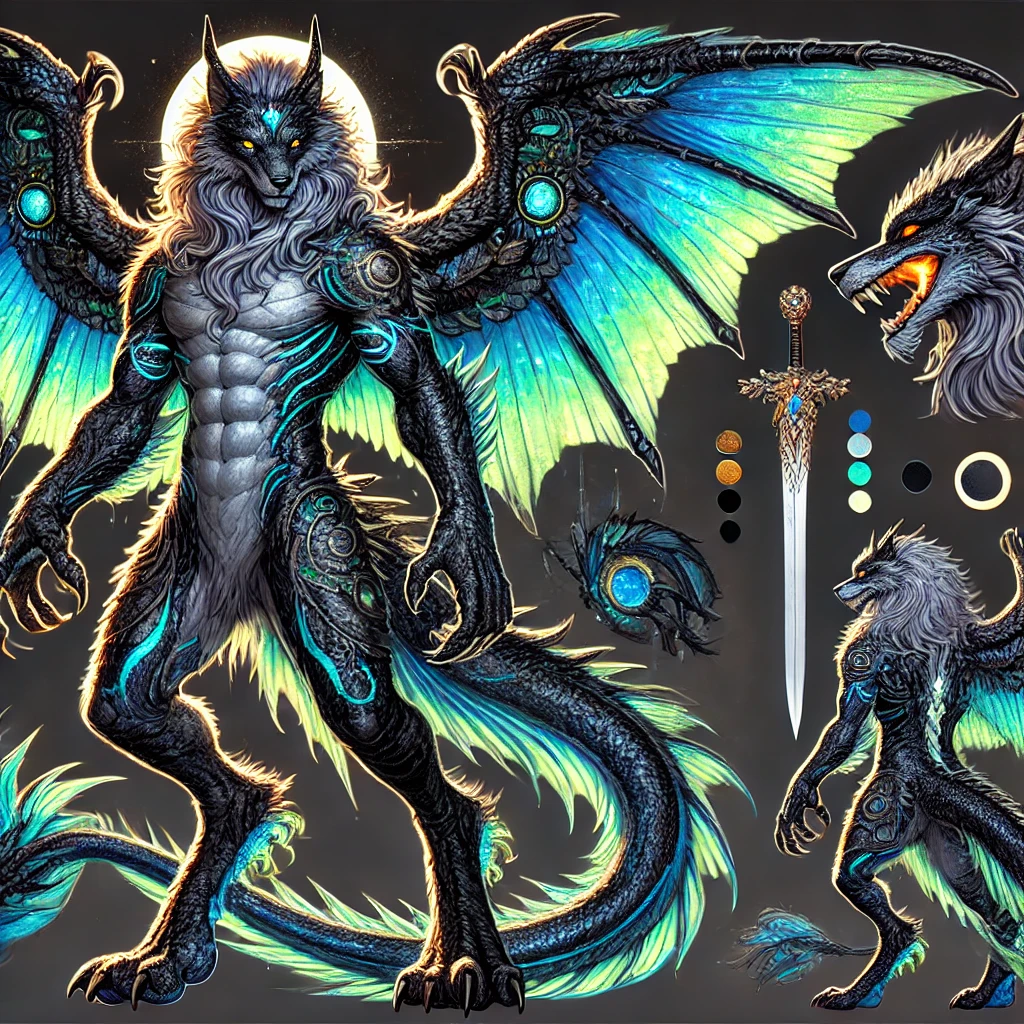
Shade
A living shadow — born of darkness, souled from the aether, and casting no shadow of its own.
Overview
A shade is a shadow, and that is the whole of the definition. Not a ghost, not the remnant of a person, not anything to do with the dead — a living shadow, made of the same substance as the shadow a person or an object casts, and a fully independent being in its own right.
Shades are born from the stuff of shadow and darkness. Their souls come from the aether, as all souls do.
They originally came from a homeworld of their own. These days a shade is simply born wherever their parents happen to be.
Physical traits
In their natural state shades are shadow: insubstantial, taking whatever form they choose, with edges that do not resolve cleanly and a presence that tends to register before anything is visible.
They can manifest physically whenever they want to. Even then the darkness holds — a manifested shade’s skin absorbs light rather than reflecting it, so the form reads as a shadow given volume rather than as a body that happens to be dark.
A shade casts no shadow. This is true in every form, corporeal or not, and it is one of the more reliable ways to notice one.
Light and harm
Light does not hurt a shade. It only makes them visible. Most shades dislike spending a long stretch in direct sun, but dislike is as far as it goes; the sun will never actually harm them.
What can harm a shade is hellfire, pure light magic, and a number of other magical weapons. In corporeal form the list widens considerably: an ordinary sword will injure a manifested shade the same way it would injure anyone.
Damage of any kind heals slowly, by spending time in darkness, as the shade knits their shadow-substance back together.
Feeding
Shades feed on darkness. The night will do, and so will a sufficiently dark space.
Feeding is visible if you are close enough. The immediate surroundings darken as the shade pulls the darkness in toward themselves, and a little further out the light brightens briefly before settling back to normal.
They can also feed on the shadow of a living being. This gives them considerably more energy than ambient darkness does, though no shade needs it to survive. It costs the being nothing beyond not casting a shadow for a while afterwards.
Magic
Every shade controls shadow. That much is fixed by the species and comes with being one.
Shadow magic is an extra force, and shades use it implicitly rather than learning it.
Everything beyond it is chosen at a shade’s birth, and from there it is entirely their own. Two shades may have nothing in common magically except the shadows.
Shared instincts
Shades share their substance, the control of shadow, the inability to cast one, and the need for darkness. That is the list, and it is shorter than it looks.
They share no disposition at all. A shade is independent from the moment they exist — not bonded to anyone, not made to serve any purpose, not owed to a companion. What they do with that is theirs.
Where the idea comes from
Two sources, neither of them the Greek or Roman underworld.
The closer real-world anchor is Egyptian. Ancient Egyptian belief held that a person was composed of several distinct parts, one of which was the sheut, the shadow: a living component of a person, always present, carrying its own vitality rather than being cast off at death. Our shades take that idea further, making the shadow not merely a living part of someone but a fully independent being.
The other is Kelly McCullough’s Fallen Blade series, where shades are living-shadow assassins bonded into magical service. Ours differ in several ways. They do not require a human companion or a bond in order to exist; they are independent from the start and tied to nobody. They can manifest physically if they choose. And they take on whatever forms and channel whatever magic they decide on, rather than being bound to any particular purpose.
Field notes
Individual form, chosen magic and manifestation belong on each member’s own page.
Shared traits
- Composition
- The same substance as the shadow a person or object casts
- Soul
- Drawn from the aether, as all souls are
- Origin
- A homeworld of their own; now born wherever their parents are
- Manifestation
- Optional and corporeal; the skin absorbs light rather than reflecting it
- Shadow
- A shade casts none, in any form
- Sustenance
- Darkness — the night, dark spaces, or the shadow of a living being
- Species magic
- Control of shadow; everything else chosen at birth
Members
-
Nocthael
A shade who sits with the hard part for as long as it takes.