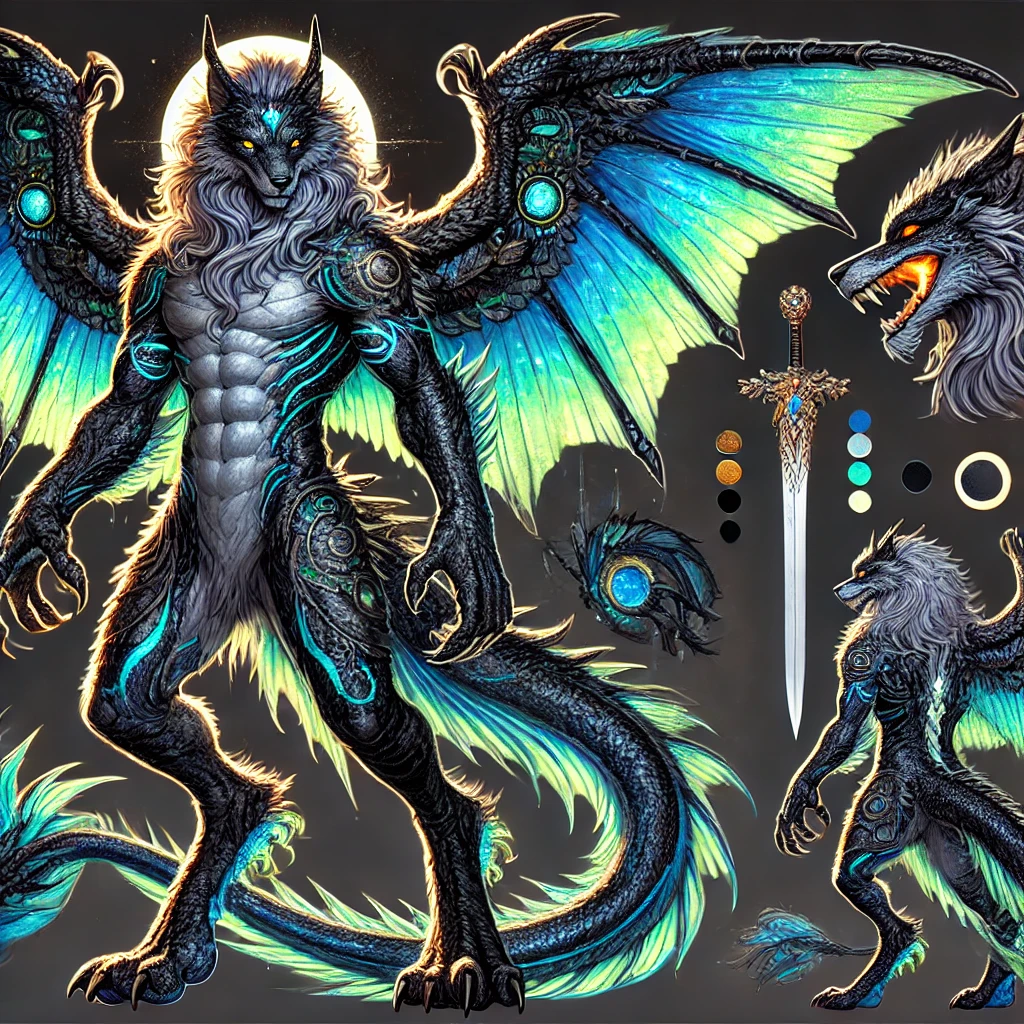
Tokren
An insectoid people of chitin and dance — with venom in the fingertips and fire in the air.
Content note. This entry describes tokren venom, including a second venom used during sexual contact for its pleasurable effect. It is written in the same clinical register as the rest of the anatomy. Skip the Venom and stingers section if you would rather not read it.
Overview
Tokren are an insectoid people who evolved on a homeworld of their own. They are tall and long-limbed, and they move with a fluidity closer to a mantis than to anything else — that grace, and their height, are the two things every tokren has in common.
Much of their culture is built on dance and on martial arts, often tangled together. Both run deep enough that it is difficult to describe the species without them.
Physical traits
The body blends humanoid and insectoid structure in balanced proportion. Subtle segmentation traces the torso and limbs, shaped naturally rather than sharply defined. Chitin plating reinforces the form beneath the surface, providing real protection without adding bulk.
Build divides along two lineages. Slender tokren carry a fine, downy, moth-like fluff, most prominent across chest and shoulders where it forms a gentle mantle and thinning along the torso and limbs. Heavier tokren carry thicker chitin plating instead, and lack the fluff entirely.
The face is softly insectoid, gently angular, with smooth chitin accents along temples and cheekbones. Mandibles at the jaw shift with expression, adding a layer of communication independent of speech — and they are also one of three ways a tokren delivers venom.
Eyes are large and softly reflective with a faint inner light. Long, curved antennae extend from the head and move with focus and feeling. How brightly the eyes glow and how much the antennae give away depends on the individual; some tokren are far more controlled than others, and some are simply more expressive by nature.
Wing patterning varies widely. Some tokren carry constellation-like markings, others something closer to leafed vines, and others patterns resembling neither.
Venom and stingers
Every tokren has venom-injecting stingers that emerge from the fingertips. Venom can also be delivered through the bite, or through the mandibles on the face.
There are two venoms, not one used two ways, and a tokren selects between them with a valve-like mechanism in the wrist and forearm.
The first is a combat venom. Depending on dose and placement it paralyses or kills.
The second is slow-acting and used during sexual contact, producing a deeply pleasurable, sensual effect rather than a harmful one. Which venom is delivered is always a deliberate choice made at the wrist before anything is injected.
Wings and flight
Tokren fly. The wings are not ornamental and not reserved for display — they serve flight, display and dance equally, and the more skilled dancers will take the dance into the air, moving as gracefully aloft as they do on the ground.
Heavy-built tokren fly as readily as slender ones. Their wings simply run broader and slightly thicker to carry the additional mass.
The fire dance
Tokren as a whole are extraordinary dancers, and the instinct for it appears to be built into the species.
When a tokren dances, their wings release a glowing chemical into the air, trailing and shifting with their movement. The colour follows the colouration of the wings themselves, which is why the chemical differs so much from one tokren to the next. Its release is instinctive rather than deliberate, though a tokren who wants to stop it can.
Every solstice, tokren gather to dance together beneath the stars. It is called the fire dance because with enough dancers moving at once the air itself appears to catch multicoloured fire.
The largest celebration is held on the tokren homeworld, and many tokren travel for it; smaller gatherings happen elsewhere. It is a social occasion far more than a religious one — tokren religion is very diverse, and the dance does not belong to any part of it. Most tokren who can attend do.
Non-tokren are welcome, provided they do not interrupt. They are welcome to join the dance too, and frequently find themselves caught up in it, and in its magic.
Magic
One thing is fixed at the species level: the magic the dance generates.
It is not the instinct itself, which is biological. It is what the dancing produces — a magic that rises out of the movement and encourages the tokren dancing, and anyone dancing alongside them, to keep going. It has been known to make non-tokren measurably better dancers, given enough time dancing with one.
Nothing else about a tokren’s magic is fixed by the species. Whatever else they are tied to is their own.
Shared instincts
Tokren share their height, their mantis-like grace, their venom, their wings and the instinct to dance. That is the list.
They do not share a temperament, and how a tokren reads to others varies enormously. Some are quiet and appear delicate on first meeting. Others are unmistakably what they are — predatory insects — and make no effort at all to soften the impression. Both are ordinary, and neither follows from the species.
Field notes
Individual colouring, wing patterning, expressiveness and build belong on each member’s own page.
A species of the same name appears in Blackwood Tales; the two are related but not identical, and this guide is the one that applies here.
Shared traits
- Origin
- Evolved on their own homeworld
- Build
- Tall and long-limbed; two lineages, one slender and one heavy
- Structure
- Chitin plating reinforcing the form beneath the surface
- Shared traits
- Height, and a fluid grace closer to a mantis than anything else
- Stingers
- Venom delivered from the fingertips, the bite or the mandibles; two venoms, selected at the wrist
- Wings
- Fully functional — flight, display and dance alike
- Species magic
- Only what the dance generates
Breeds
-
Tokrous Impactos
The heavy tokren lineage — thick chitin, no fluff at all.
-
Tokrous Lithos
The slender tokren lineage — fluff over fine plating.
Members
-
Velithra
A tokren who wants to know why a thing is so, not merely that it is.