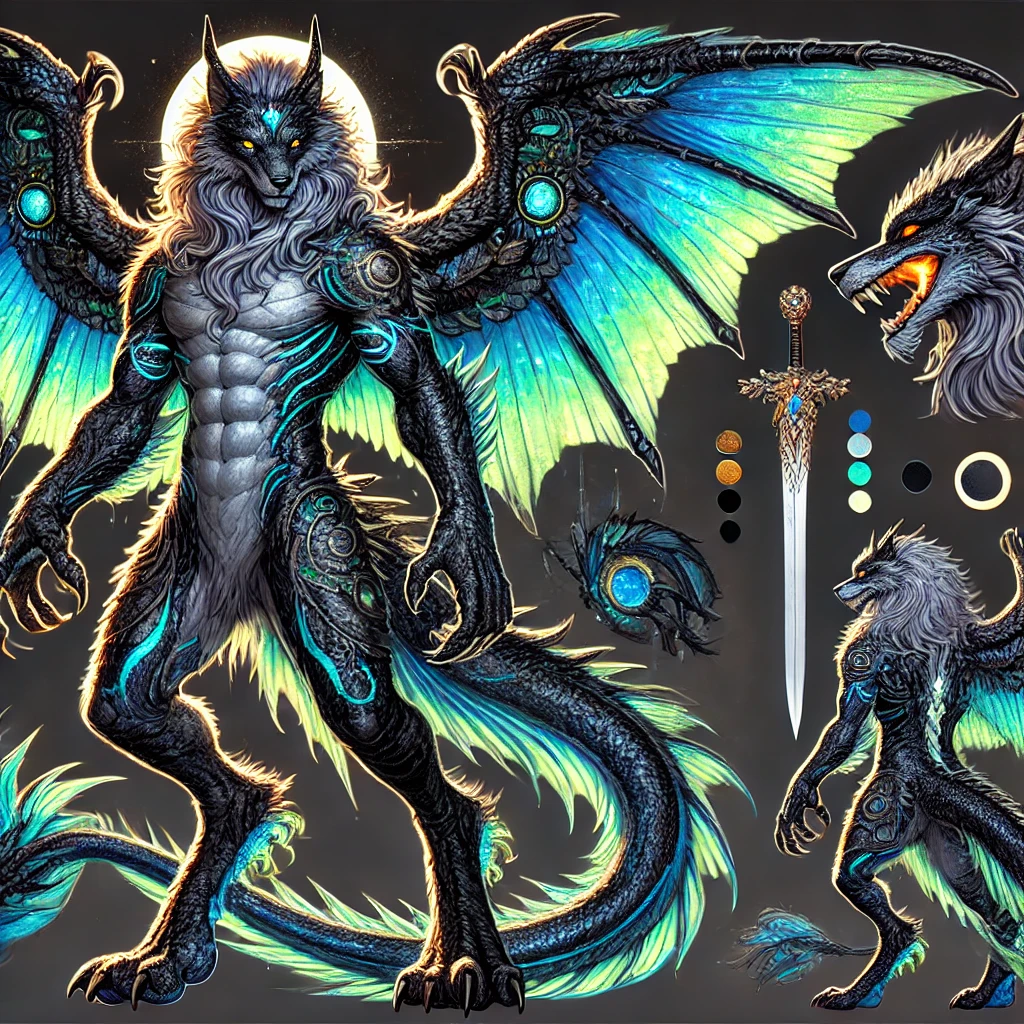
Jorōgumo
Spider shapeshifters whose silk almost nothing can cut — hellfire included.
Content note. This entry describes jorōgumo venom, including a use during sexual contact. It is one short section — Venom — and the rest of the entry has nothing comparable.
Overview
Jorōgumo are spider shapeshifters. They are born as they are rather than transforming into it at some age, and they shift fully between spider, human and every point in between, the same way kitsune do. None of those forms is a disguise and none is more real than the others.
They were born on this plane, and like the other magical species that originated here they now live within the Veil.
Gender is individual, not a species trait. The tradition’s near-universal she does not carry over.
Silk
The silk is the reason to pay attention.
It is magically protective, and very few things get through it. Even hellfire struggles, though how well it holds depends on the individual power of the jorōgumo who spun it against the power of the demon whose fire is being thrown at it.
It is also physically extraordinary. No ordinary blade will cut it. The jorōgumo who spun a web, however, can take it down with next to no effort.
And it is soft. Anyone who has lain inside a friendly jorōgumo’s web will tell you it is among the softest things they have ever touched.
Venom
Jorōgumo venom has three uses. It can paralyse. It can induce unconsciousness. And during sexual activity it can be used to produce waves of pleasure and warmth instead.
Magic
The silk is the one thing the species fixes — its protective quality is magical, and every jorōgumo has it.
Nothing else is fixed. Whatever else a jorōgumo is tied to magically is their own, and there are no jorōgumo breeds.
Shared instincts
Jorōgumo share the patience, the silk and the skill of a spider. They remain predators at heart, and they feed on living beings much as most other creatures do — no species is particular to them.
Being a predator says nothing about what any of them hunts. That is a choice, and they make it individually. Some might seek to trap, others to shelter, others simply to make a home. The thread that connects things belongs to Sylveth specifically and is not a species trait.
Where the name comes from
The jorōgumo of Japanese folklore is a yōkai: a spider that survives some four hundred years, acquires magical power, and takes the form of a beautiful woman who lures men, binds them in silk and devours them. The name is written 絡新婦, “entangling bride”, and is shared with a real animal — Trichonephila clavata, the golden orb-weaver common across Japan.
We take the spider, the silk and the patience. The transformation at four hundred years, the trapper, the evildoer and the woman preying on men are all left where they were found.
Field notes
Individual form, presentation, gender and chosen magic belong on each member’s own page.
Shared traits
- Origin
- Born on this plane; now live within the Veil, as earth-born magical species do
- Form
- Spider, human and everything between; full shifting, not disguise
- Silk
- Magically protective and physically near-uncuttable — and extraordinarily soft
- Venom
- Paralysis, unconsciousness, or waves of pleasure and warmth
- Gender
- Individual, not a species trait
- Species magic
- The silk, and nothing else
Members
-
Sylveth
A jorōgumo who weaves shelters rather than traps, and waits before he acts.