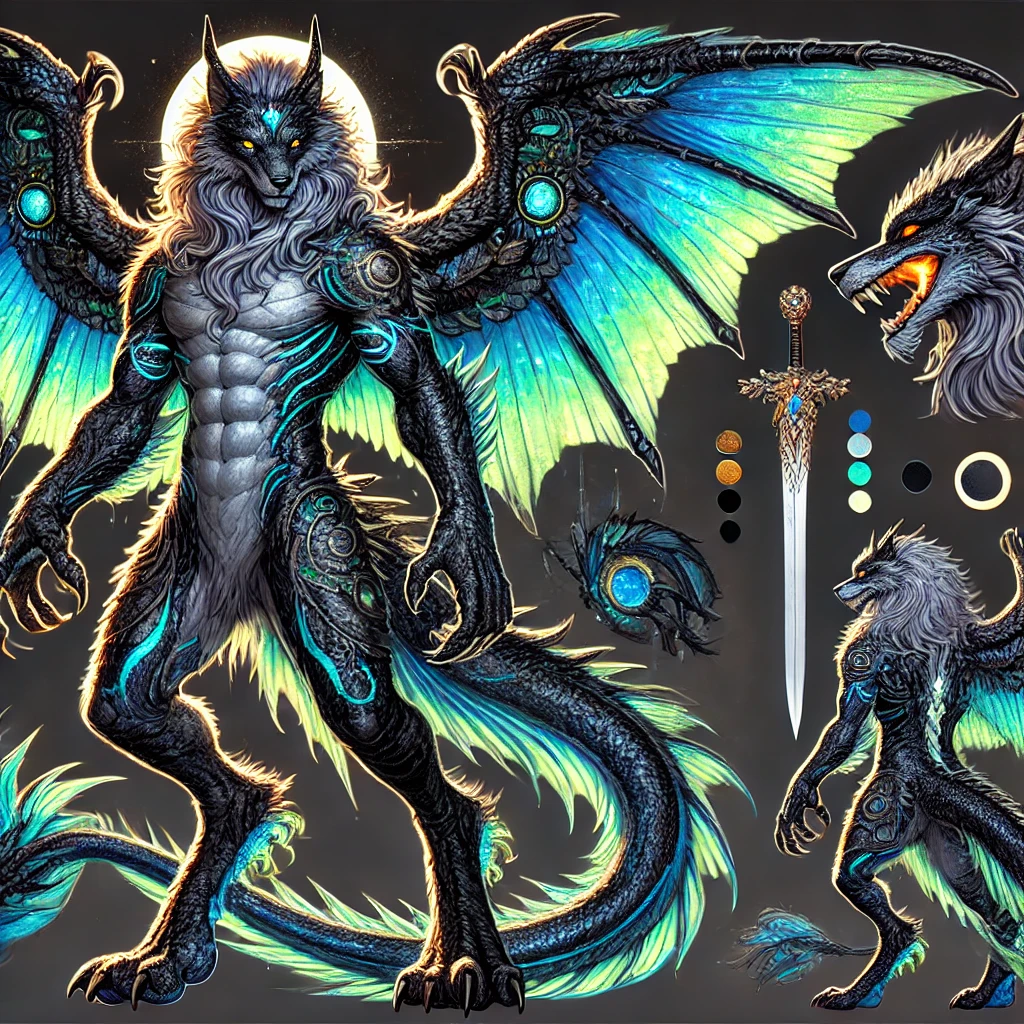
Phoenix
Fire that burns inside and out — and a death that is incidental rather than owed.
Overview
A phoenix is a creature of fire. It burns within them and on them, and they command it — the flames across the body can be made harmless to everything they touch, or put out entirely, at will.
They were born here, and they live in the Veil now.
There are no known phoenix breeds.
The cycle
A phoenix is reborn from ash, and the one who rises is the same person. Memory and identity carry through intact. What each cycle brings is a rebuilding of strength.
Two things set it off: reaching a certain age, or taking a major injury that does not kill outright. The age threshold is not constant — it lengthens with every cycle completed, so the interval between rebirths grows longer the older a phoenix gets.
Death is not the point of any of this. A phoenix is not reborn because it must die first, and not because it has earned or paid for anything. It is reborn because fire is what it is. The dying is incidental to that.
Permanent death
A phoenix can be killed for good, but it has to be done instantly. Anything short of that and the phoenix will destroy itself in order to be reborn.
Even then the body is not immediately destructible. It cannot be burnt until it no longer holds its elemental fire, and depending on the phoenix’s age that can take anywhere from a month to two years.
Magic
Phoenix fire is an extra force, not the elemental fire of the fundamental forces. It burns, and it also purifies and heals poison — which is not something ordinary fire does, and is a fair example of why extra forces sit outside the usual structure.
Beyond the fire and the cycle, nothing is fixed. Whatever else a phoenix is tied to is their own.
Physical traits
Phoenixes carry a partial shapeshifting ability. They can take on more anthropomorphic traits at will, though a fully human form is not innate to them.
Plumage and colouring vary by individual.
Shared instincts
Phoenixes share the fire, the cycle and the partial shapeshifting. Nothing else generalises.
Temperament in particular does not. Aelzephyra’s patient, absolute way of being belongs to her, and it is not what a phoenix is.
Where the name comes from
The phoenix is a solar bird of Greek tradition drawn largely from the Egyptian bennu, a heron-like bird associated with Ra and with creation. The earliest surviving description is Herodotus, reporting sceptically what he was told at Heliopolis — noting he had never seen one himself “except in a picture”.
We draw on that older Greek and Egyptian material rather than the later Christian reading. In the older tradition the phoenix is not reborn as a sacrifice or a price paid; it lives for centuries, is consumed by its own fire or builds a nest that catches flame, and rises from what is left. The moralised version — death as necessary sacrifice, resurrection as its reward — is a later addition, and we depart from it deliberately.
Field notes
Individual plumage, colouring, cycle count and manifestation belong on each member’s own page.
Shared traits
- Origin
- Born here; now in the Veil
- Fire
- An extra force — it purifies and heals poison as readily as it burns
- Rebirth
- The same person returns, memory and identity intact
- Cycle
- Triggered by age or by major injury; the interval lengthens with every cycle
- Permanent death
- Possible, but it must be instant
- Shapeshifting
- Partial — anthropomorphic traits, but not a full human form
Members
-
Aelzephyra
A phoenix who slows the moment down when everything else is speeding up.