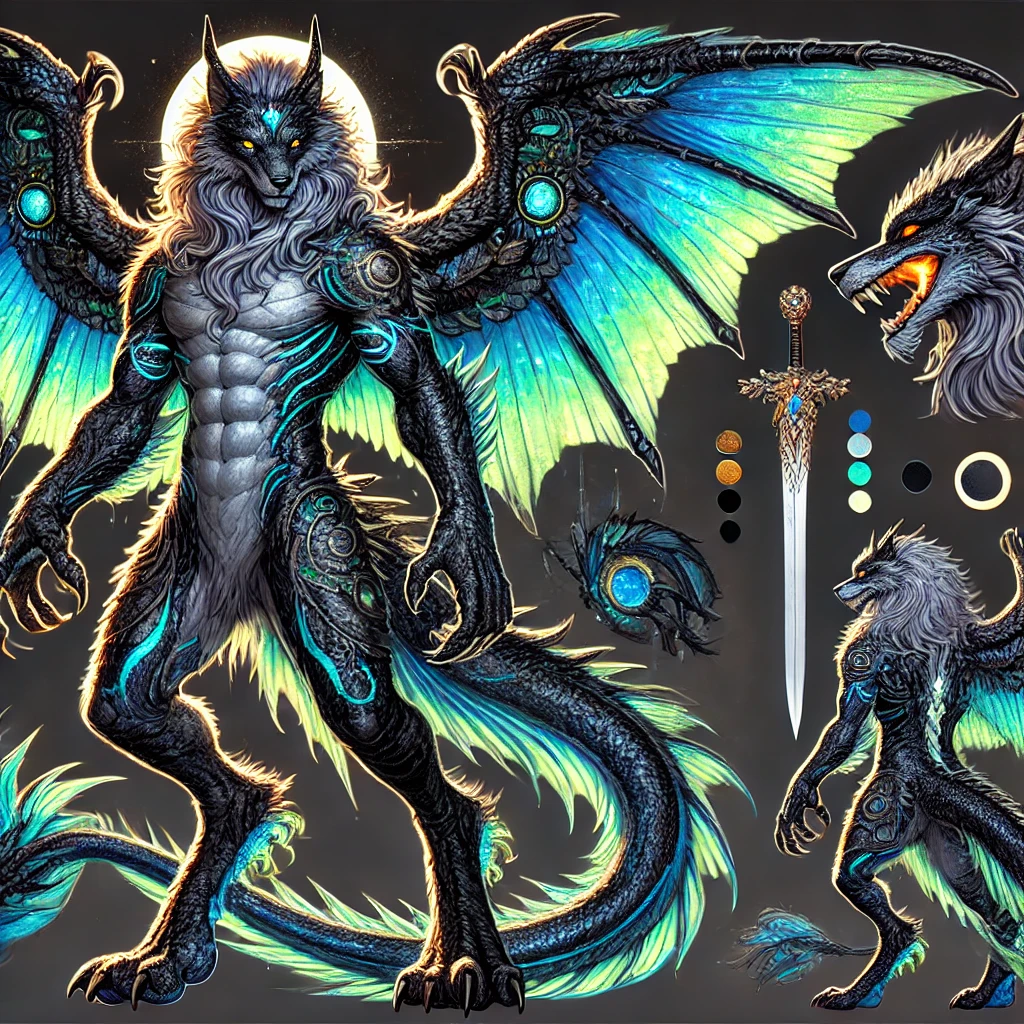
Sorberanth
A serpent whose face opens like a flower, and who keeps a piece of everything it has ever swallowed.
Content note. This entry describes the absorption, which requires swallowing a living creature whole and kills it every time, and describes the two venoms, one of which is used for pleasure. The absorption and Venom and blades are the sections to skip.
Overview
A sorberanth is a serpent that grows by taking things into itself.
The serpentine body is theirs and stays theirs — length, scale and stinger, holding from one end of a life to the other. What changes is what gets built onto it. A sorberanth who swallows a living creature whole comes away carrying that creature’s magic entire, its soul, and enough of its biology to show, and every one of those additions is permanent.
They live in the Veil. There are no sorberanth breeds; what varies, varies by individual, and a great deal varies.
Physical traits
Sorberanths run from around ten feet to around thirty, and where any of them falls in that range is their own.
The body a sorberanth starts with is serpentine the whole way through. No legs, no paws, nothing that resolves into a limb — length is the entire structure, and everything a young sorberanth does, it does with it.
Limbs do turn up, and they arrive by absorption. A sorberanth who has taken in a creature that walked may well have legs now, or paws, or arms, and those are as much theirs as the length they were born with. What holds for every sorberanth is the serpentine baseline underneath: the absorption builds onto it and never replaces it, so however much a sorberanth has accumulated, the shape it was added to is still there.
The scales are fine and set very close together, and the density is what makes them protective. Colouring and patterning shift from one sorberanth to the next.
Four eyes sit in the face, in two pairs. The forward pair faces front and does the work of depth, judging distance and holding a thing in focus. The second pair angles out to the sides and reads movement across a much wider field. A sorberanth attends to both at once, without either one costing the other anything.
The face and the maw
Closed, the face is draconic, and the snout is the main event — long, heavy, and carrying the shape. The mouth beneath it looks modest, and no seam shows anywhere. There is nothing on a closed sorberanth face to suggest it does anything unusual.
It comes apart. The sides of the face draw back and outward the way a flower opens, folding away from the centre to reveal the true maw, which is enormous and is the whole point of the arrangement.
How many sections it opens into is a fact about the sorberanth rather than about whatever they are opening for. A small one divides into two halves. A large one divides as far as ten separate sections.
This is how a sorberanth eats, and it is how the absorption happens.
The absorption
A sorberanth can swallow a living creature whole, and doing so takes that creature into them permanently.
It kills. Every time, without a gentler version available. The creature goes down alive, and what comes out the other side of the process is a sorberanth carrying pieces of it.
It is never necessary. Sorberanths eat to live the way anything else does, and the absorption sits on top of a need already answered. No sorberanth has ever had to do it, and one who never does is a perfectly ordinary sorberanth. It is a decision, made one creature at a time by whoever is making it.
The only limit is the swallow. Any living thing can be absorbed, magical or otherwise, and nothing caps how many a sorberanth may take across a life. What constrains it is purely mechanical: the creature has to go down whole, and it has to go down alive.
What arrives
The magic comes entire. Whatever the creature was tied to, the sorberanth is now tied to. Nothing is diluted on the way in and nothing is left behind.
The reason sits in where magic is held. A creature’s magic lives in its soul, and the soul goes in whole, so the magic travels with it and there is no point in the process at which any of it could be set aside. A sorberanth chooses the creature and chooses the memories. What magic arrives is settled by the swallow, which means a sorberanth can finish an absorption carrying something they would never have gone looking for.
The biology comes partially, and it shows. A sorberanth who takes a dragon comes away with wings, and likely more besides. One who takes a kitsune comes away with tails, and quite possibly a set of large fox paws. Which aspects arrive varies, and the arrival is visible — this is a body that accumulates a record of itself.
The instincts come with the body. What a creature knew in its reflexes arrives along with the parts those reflexes belonged to: the drives, the instinctual skills, the things it never had to learn.
The soul comes as material. It goes in the way everything else goes in, and it is taken up. Whoever that soul belonged to ends there.
The memories
Memories are the one part of it the sorberanth chooses.
They can take them or leave them, and taking them is a heavier thing than it sounds. A sorberanth who takes a creature’s memories can be changed considerably by them — carrying that being’s recollections tends to pull the sorberanth toward being more like them, sometimes a long way toward it.
It never arrives all the way. However much of someone a sorberanth takes on, they remain a sorberanth wearing an influence, and the person those memories came from stays gone.
Distinct from the gumiho
The comparison is worth drawing, because the two seem similar at a distance and work nothing alike.
A gumiho eats to live, and what the deepest taking gives them is a wearable shape — the creature’s form and abilities enter a range they can move through at will, and they can wear the exact face it came from.
A sorberanth keeps their own body throughout. There is no range, no wearing, and no second shape to move into. What they take gets built into the one body they have and stays built into it, and it is a choice on top of a need that was already met rather than the deepest end of feeding.
Distinct from the chimera
A chimera is born with their composition and keeps it. It is fixed at the outset, it never shifts, and it is complete on arrival.
A sorberanth assembles theirs. Every part that came from somewhere else was added deliberately, by them, at some point in a life that keeps going — which is why two sorberanths of the same age can look nothing alike, and why a sorberanth’s body is a biography where a chimera’s is a birth.
Venom and blades
The tail ends in a stinger, and it carries two venoms.
The first paralyses or kills, depending on dose and placement. The second is pleasant and sensuous, and produces nothing harmful at all. One stinger delivers both, and which one goes in is chosen freely by the sorberanth at the moment of delivery.
Running the length of the tail are retractable blades, fin-like when extended and flush with the body when withdrawn. They carry both venoms as readily as the stinger does. They cut, and they push water — a sorberanth swims well with them, without being a creature of the water particularly. The capability is simply there.
Movement
Sorberanths swim, climb and burrow, and they do all three well.
No one terrain is home. A sorberanth in water, a sorberanth in the branches and a sorberanth underground are all equally where they belong, and where any of them spends their time is a preference rather than a fact about the species.
Ageing
Sorberanths grow, and at some point they stop, and when that happens depends on the individual.
After that they simply keep going. A sorberanth does not die of old age.
Magic
Two things are fixed.
The first is the absorption, and it is an extra force — older and stranger than the ordinary structure of magic, in the way kitsune shifting and soul-stealing are, and in the way the gumiho taking is.
The second is the venom, carried by every sorberanth in both of its forms.
Everything past those two is individual, and for this species that clause carries more weight than it does elsewhere: whatever a sorberanth has absorbed is now theirs as well, and no two of them accumulate the same things.
Shared instincts
Sorberanths share the serpentine body, the four eyes, the opening face and the maw behind it, the absorption, the stinger and blades with their two venoms, and the ageing pattern. That is the list.
They do not share a temperament, and a body built to swallow things whole invites a reading it does not support — that its owner is an appetite with a length attached. A sorberanth may be quiet company, or funny, or exacting, or content to talk to one person for an entire evening, and how any of them carries themselves is their own. What they have absorbed says something about the choices they made. It says nothing about what they are.
Where the name comes from
The name is built rather than inherited, and it comes from two roots.
Sorb is the Latin sorbēre — to suck in, to swallow, to absorb. It is the root sitting inside English absorb, and it describes taking something into yourself without any appetite attached to it, which is the distinction that mattered here.
Anth is the Greek ἄνθος, anthos — flower, blossom. It is there for the face, which opens outward in sections the way a bloom does.
The -er- between them is the linking vowel of the Latin infinitive stem, carried through so the two roots meet cleanly. It means nothing on its own and is not pretending to.
The absorbing bloom is the reading.
Field notes
Individual size, scale colouring and patterning, how many sections a sorberanth’s face opens into, what they have absorbed and what of it shows, whether they took the memories along with the rest, and whatever magic they carry beyond the species’ own all belong on each member’s own page.
Shared traits
- Origin
- The Veil
- Body
- Serpentine end to end at baseline; limbs arrive only by absorption
- Size
- Ten to thirty feet, by individual
- Scales
- Fine and very close together, and protective for it
- Eyes
- Two pairs — one forward for depth, one angled to the sides for movement; both attended at once
- The maw
- The face opens back in sections — two halves in a small sorberanth, up to ten in a large one
- The absorption
- An extra force; it takes a creature's magic, soul and biology, and adds them permanently
- Stinger
- Two venoms from one stinger, chosen at delivery; the tail blades carry both
- Ageing
- They grow, then stop; they do not die of old age
Members
-
Sangrahin
A sorberanth carrying five lives in one body, who would rather spend an evening asking you questions.