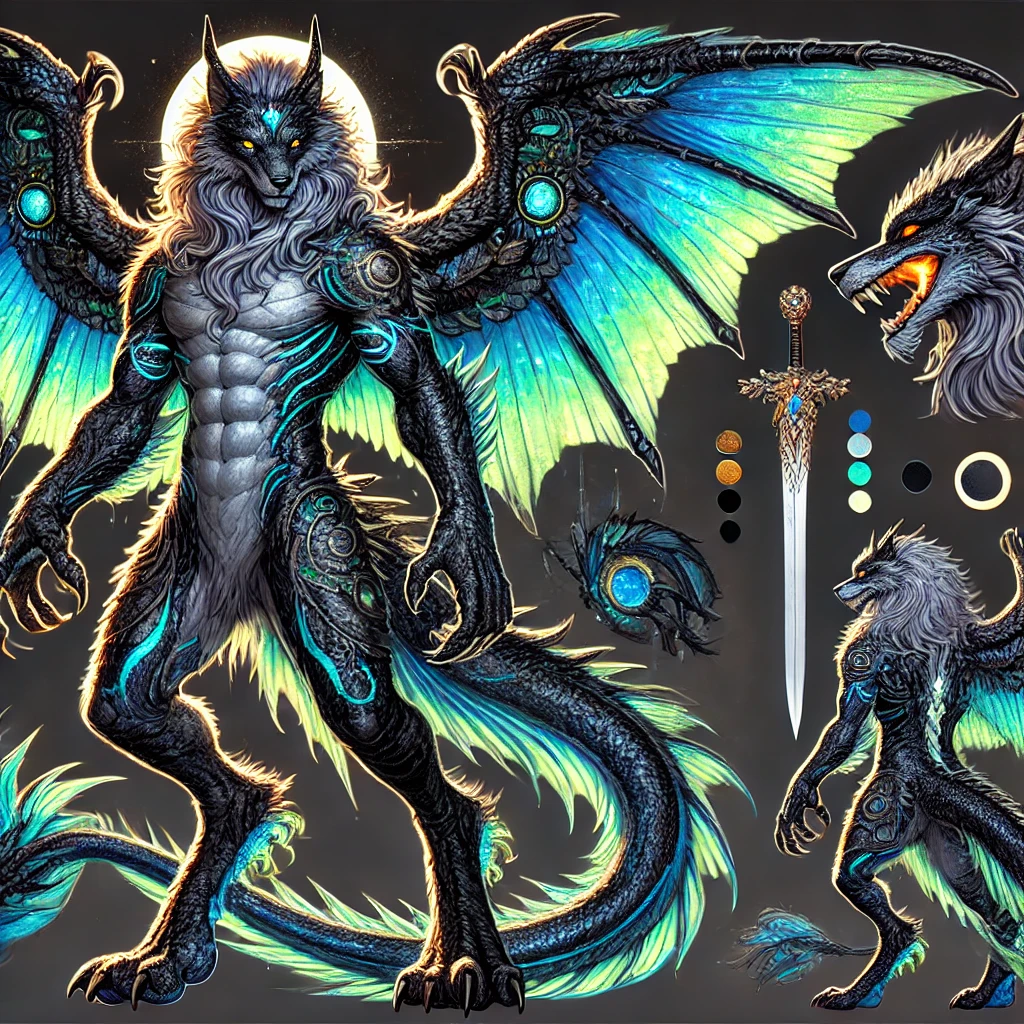
Wyvern
Two legs, two wings, and venom that carries the element in its own right.
Content note. This entry describes wyvern venom, including the expression used for pleasure during intimate contact. It is confined to the Venom section.
Overview
Wyverns have two legs and two wings, and that is fixed — there is no variation in the body plan. They grow larger as they age.
They spread out quickly and widely, much as dragons did. The two species come from the same root and are distant cousins, but they are not the same thing, and the clearest difference is in how the element gets out.
Shapeshifting is not innate to them.
Elemental power
A wyvern’s element is fixed by bloodline, and it channels through the claws and the wings.
That is a deliberate difference from dragons, who channel through the breath and tail. A wyvern has no elemental breath at all; the power comes out through what they strike and fly with instead.
The element is the same one that runs through their venom, so each bloodline carries a single consistent elemental identity across both systems rather than two unrelated traits.
Venom
Every wyvern carries venom. It is an extra force rather than a fundamental one — it does not behave like an ordinary elemental affinity, and the biology it runs through is part of what makes the bloodlines breeds rather than mere magical variants.
Delivery is by bite, by tail, or by both, and this does not track the elemental bloodline. A wyvern of any element may end up with one, the other or both. Tail-only is rare but does happen.
What the venom does once delivered follows the element. Every element has two possible expressions — one harmful, one that produces pleasure rather than pain — and which is delivered is the wyvern’s own choice, made in the moment according to the situation. The pleasurable expression takes its character from the same element as the harmful one.
Fire burns and cauterises as it spreads, or delivers a spreading heat and a deep flush.
Water fills and drowns, a heaviness settling in the chest, or a warmth like being submerged and carried. Frost-aligned wyverns are a subset of the water bloodline and their venom runs differently: it numbs and stiffens, or produces a cool weightlessness, a numbness that reads as floating.
Earth stiffens toward petrification under a crushing weight, or grounds the body into a heavy, settled calm.
Storm causes convulsion, or sends tingling waves and shivers running through the body.
Magic
The species fixes the element, the venom and the claws-and-wings channelling. Everything else a wyvern is tied to magically is their own.
Shared instincts
Wyverns share the body plan, the venom, the elemental bloodline and the way they channel. That is the list.
They do not share a disposition. Therynna’s patience and her turn for navigation are hers individually — the traveller and the navigator are not what a wyvern is, and wyverns vary in temperament as much as any other people.
Where the name comes from
The wyvern is a heraldic beast rather than a folkloric one, defined structurally: two legs and two wings, where the heraldic dragon has four legs and two wings. The name descends through Middle English wyver from Old French wivre, and ultimately from Latin vipera, a viper — the serpentine root is older than the draconic association.
We take the body structure and the magical nature. We do not take the pestilence and war associations some of the tradition carries, and we do not take the windborne quality heraldry sometimes attaches to it.
Field notes
Individual colouring, delivery method and manifestation belong on each member’s own page. The elemental bloodlines are recorded as breeds below.
Shared traits
- Origin
- Spread widely and quickly, much as dragons did
- Form
- Two legs and two wings — fixed across the species
- Element
- Set by bloodline; the elemental bloodlines are the breeds
- Venom
- An extra force; delivered by bite, by tail, or by both
- Elemental power
- Channelled through the claws and wings, never the breath
- Kin
- Distant cousins of dragons, from a shared root
Breeds
-
Earth Wyvern
The earth bloodline — venom that stiffens toward stone, or grounds the body completely.
-
Fire Wyvern
The fire bloodline — venom that cauterises, or floods the body with heat.
-
Storm Wyvern
The storm bloodline — venom that convulses, or runs the body through with shivers.
-
Water Wyvern
The water bloodline — and the frost-aligned subset within it.
Members
-
Therynna
A frost-aligned wyvern who has usually found the way before anyone knew one was needed.