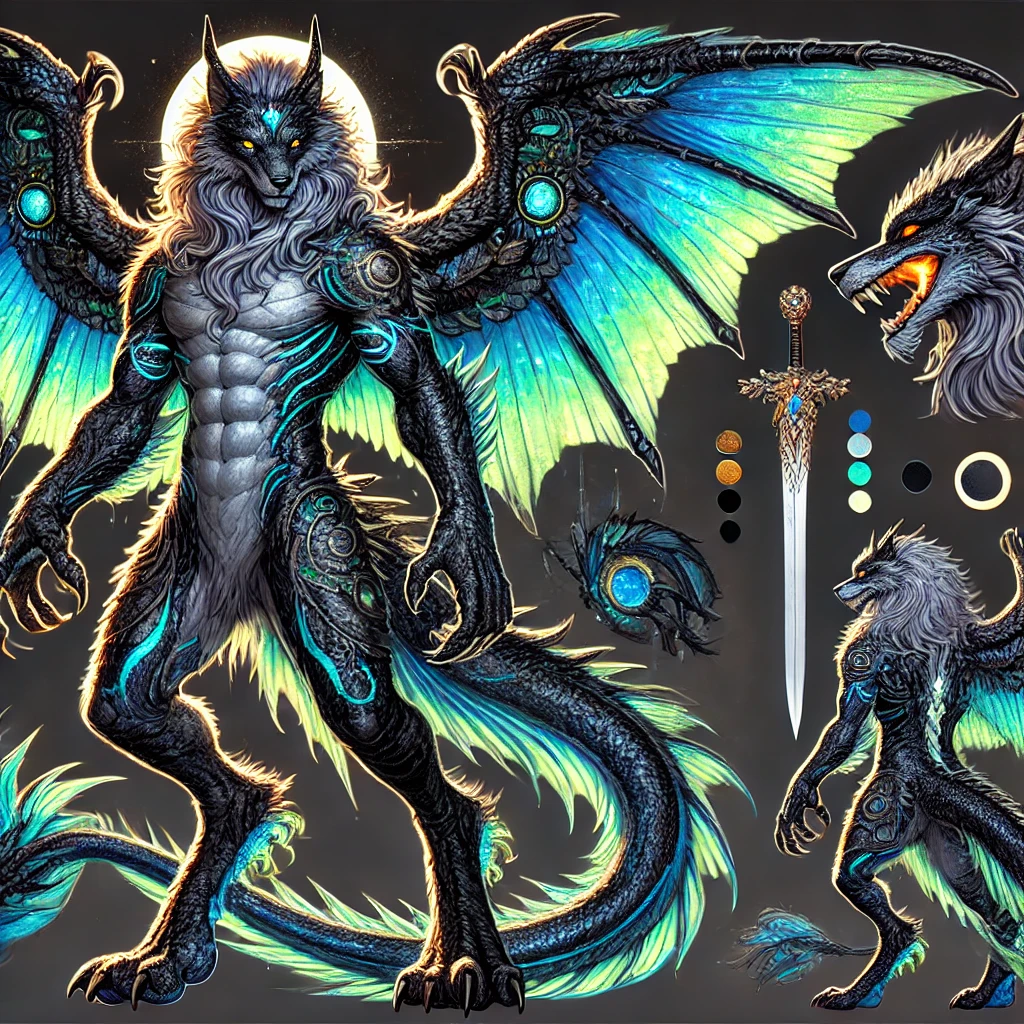
Chimera
A species defined by variation itself — no two alike, and none able to change.
Content note. This entry describes chimera venom and the mind-control effect their bite assists, including their use for pleasure between consenting people. Clinical register throughout; the Magic section is the part to skip if you would rather not read it.
Overview
There is no typical chimera, and that is the entry.
Composition varies completely from one individual to the next — limb count, head count, which lineages appear and in what proportion. Two chimeras may share nothing anatomically and both be perfectly ordinary examples of the species. The components can be species from elsewhere in this guide, and they can just as easily be things that are not.
Chimeras are born, and they can reproduce. Their offspring take almost nothing from either parent, which is a large part of why the species resists description: there is no line of inheritance to follow, only a new composition each time.
Distinct from hybrids
The distinction matters and is frequently missed.
Hybrids — dragonsune, otterlion — carry traits from their component species and can shift between them. Their anatomy sits on a living spectrum they control, letting fur and scales redistribute, features lengthen or soften, tails and wings emerge or withdraw. A hybrid’s form is a range.
Chimeras are static. Whatever composition a chimera is born with is the composition they keep. There is no shifting, no spectrum, no dialling one heritage forward and another back. The body is fixed, and it is complete.
This is why a chimera cannot be described by listing components the way a hybrid can. The components are individual biography, not species description.
Physical traits
What generalises is integration rather than anatomy. However unusual the combination, the body reads as coherent: traits meeting through genuine gradients rather than seams, every part sitting where it belongs. Nothing about a chimera looks assembled, even where the anatomy has no precedent.
Magic
Chimeras are one of the few species that fixes something, and they fix it twice over — they carry magic of their own and inherit whatever their component species carry.
Two things belong to every chimera regardless of composition.
The first is a hypnotic gaze. It channels magical hypnosis, the same extra force a lamia delivers through their gaze and a kitsune puts out as foxfire — very hard to resist, and unfailingly pleasant to be under.
The second is a venomous bite, and the venom is unusually versatile. Depending on how it is used it can paralyse, it can kill, it can produce immense pleasure and sensuousness, and it assists in the process of mind control — which is itself capable of being a pleasant experience where it is entered into consensually.
On top of that sits everything their lineages bring with them. A chimera with draconic components carries what a dragon carries; one built from something outside this guide carries whatever that thing carries. It accumulates.
Shared instincts
Very little, and deliberately so. Chimeras share the static body, the integration, the gaze and the bite. Nothing else generalises, temperament least of all — that is entirely the individual’s.
Where the name comes from
The Chimaira of Greek myth is described by Homer as “lion in front, serpent behind, goat in the middle”, breathing fire; Hesiod gives it three heads. It was the offspring of Typhon and Echidna, and was killed by Bellerophon from the back of Pegasus. English took chimera from the name, meaning an incongruous mixture or an illusion, and biology took chimerism, a real condition in which one organism carries cells from more than one zygote.
We take the word back from the English meaning. “Chimera” came to signify something that does not hold together, or does not exist at all, and the species is the refutation of that. Variation is not incoherence, and a body no one else shares is not a body in need of explanation.
Field notes
Individual composition is recorded on each chimera’s own member page, where it belongs. Do not expect one chimera to tell you anything about the next.
Shared traits
- Composition
- Varies completely between individuals; components may come from outside this guide
- Stability
- Static — structurally fixed, with no ability to shift
- Reproduction
- Born, and able to reproduce; offspring take almost nothing from either parent
- Own magic
- A hypnotic gaze and a venomous bite, carried by every chimera
- Inherited magic
- Whatever their component species carry, in addition to their own