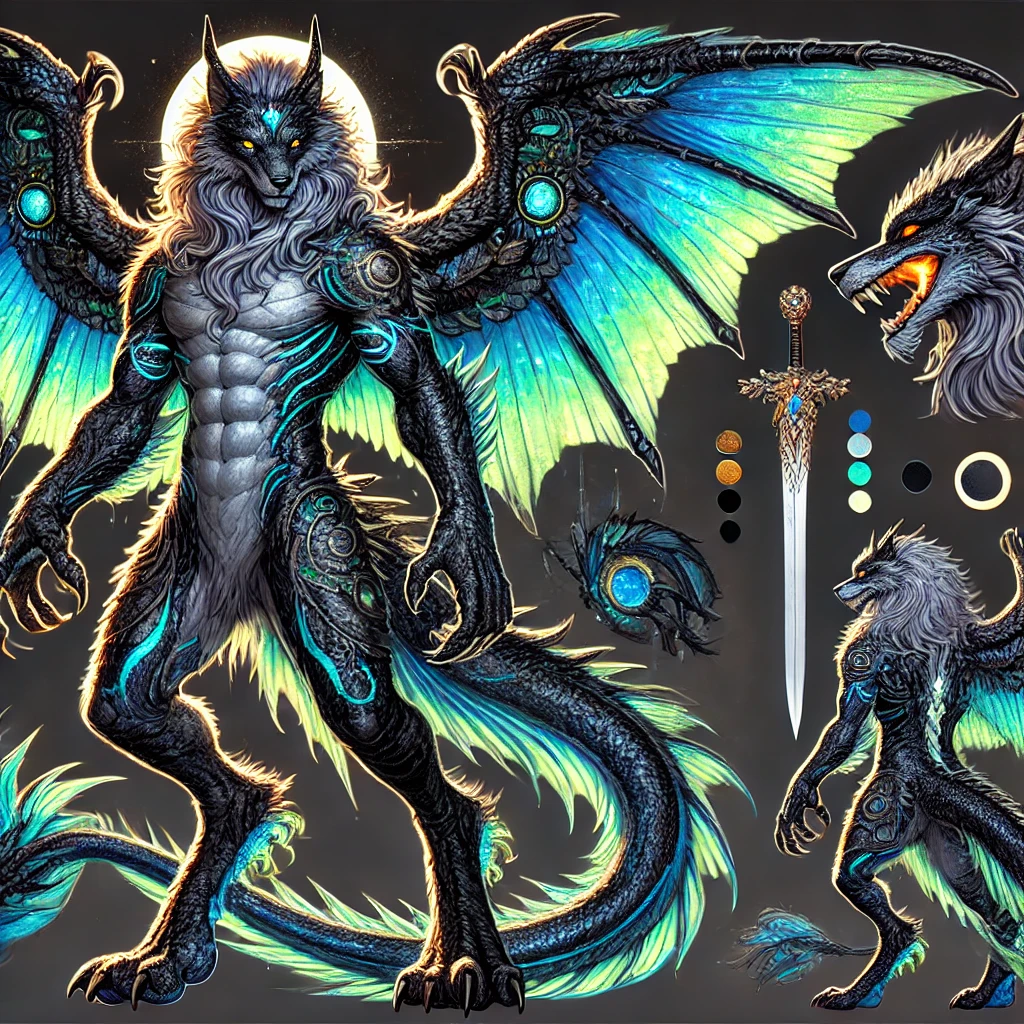
Dragon
Elemental power carried in the breath and the tail — and a species that scattered across worlds.
Overview
Dragons are an elemental people, and the element is the through-line — the character that persists whether or not anything is happening.
They did not stay in one place. After dragons came into contact with spacefaring races they spread across the world and then well past it, quite quickly. Some live in the Veil. Others, the Venutians and the Metallurgists among them, ended up with homeworlds of their own.
They and wyverns come from the same root, but the two are only distant cousins now. Leviathans are a third branch of that root, sharing it with the Solari specifically, and they have diverged a long way since.
Physical traits
There is no single dragon body plan, because the breeds diverged too far for one. The eastern and western forms are both real and both here; so are Venutians, who carry fur over hide instead of scales, and Metallurgists, whose scales are organic metal.
What generalises is less about shape than about scale and structure: a long muscular tail that matters magically as well as physically, and a body built around whatever the breed’s element or power asks of it.
Magic
Every dragon carries an element, and it is a fundamental affinity rather than an extra force — the same fire, water, earth or storm anyone else might be tied to. What makes dragons unusual is where it comes from: a dragon’s element follows bloodline rather than being the individual’s own.
It follows it loosely. Bloodline weights the outcome without settling it — two fire dragons are considerably more likely to produce a third than anything else, and are perfectly capable of producing a water dragon instead. What the parents carry tips the scales toward one element, and that is the whole of what it does.
Once a dragon has an element they keep it. It arrives with them and stays for the rest of their life, however little their parents had to do with which one it turned out to be.
The element comes out primarily through the breath, and that is the outlet most people know about. It is not the only one. A dragon also channels through the tail, and the tail is what makes more complex magic possible — breath is the blunt instrument, and the tail is the precise one.
Not every dragon’s power is elemental in the ordinary sense. Metallurgist control over metal is an extra force rather than a fundamental one, and Venutians carry toxins where another breed would carry an element.
Ageing
Dragons age and grow, and then they stop. When that happens depends on how fast the individual grew and how powerful they are.
After that they simply keep going. A dragon does not die of old age.
Hoarding
Dragons have a mild instinct toward hoarding, and some act on it. Whether any given dragon does is entirely their own, and so is what they gather — the instinct says nothing about treasure specifically.
It is worth being plain about the version of this we do not have. The hoard-guarding antagonist sitting on gold in a barrow, waiting to be killed, is not something we turned away from or decided against. It was never on the table. There is no road not taken here; that story simply is not how any of this happened.
Shared instincts
Dragons share the elemental structure, the breath-and-tail channelling, the ageing pattern and the mild pull toward hoarding.
They do not share a temperament, and several things commonly attached to dragons are not species traits at all. They are not guardians or caretakers by nature — some are, as individuals. They are not destructive by nature either; a dragon is perfectly capable of destruction, but choosing it for its own sake is not something the species does. And the restraint over avarice that Kaelaeth and Aevira both carry belongs to the two of them, not to dragons generally.
Shapeshifting into humanoid form is not innate. A spell can do it temporarily, for a dragon as for many other creatures, but nothing about being a dragon grants it.
Where the name comes from
Two traditions dominate the folklore and disagree with each other on nearly everything. The European dragon is four-legged, winged, heavily scaled and fire-breathing, and is usually something to be killed — Fáfnir, the barrow-wyrm of Beowulf, the dragon of the St George legend. The East Asian dragon — Chinese lóng, Japanese ryū, Korean yong — is long, serpentine, generally wingless despite flying, tied to water and imperial authority, and benevolent far more often than not.
We keep both, as the Lunari and Solari breeds respectively. What we take from the material as a whole is the elemental register, and not much else.
Field notes
Individual element, colouring and subtype belong on each member’s own page. Breed-level differences are recorded on the breed pages below.
Shared traits
- Origin
- Spread widely after contact with spacefaring races; some in the Veil, some with homeworlds of their own
- Element
- A fundamental affinity that leans on bloodline without being decided by it
- Channelling
- Primarily through the breath; through the tail for more complex magic
- Kin
- Distant cousins of wyverns, from a shared root
- Ageing
- They grow, then stop; they do not die of old age
- Shapeshifting
- Not innate
Breeds
-
Lunari Dragon
The western form — four legs, two wings, heavily scaled.
-
Metallurgist Dragon
Organic metal scales, and a control over metal that sits outside the elements entirely.
-
Solari Dragon
The eastern form — long, serpentine, and wingless despite flying.
-
Venutian Dragon
Fur over hide, muscle-built wings, and three toxins where another dragon carries an element.
Members
-
Aevira
A Venutian dragon who watches patterns, and decides when enough is enough.
-
Terravale
An earth dragon whose best protections are the ones nobody notices happening.
-
Talcoryn
A Metallurgist dragon whose theatre is genuine all the way down — and never once built to lie.
-
Kaelaeth
A dragon of endurance rather than frenzy — the one who refuses the alternative.
-
Kaevorin
A dragonsune whose quiet first impression hides an appetite for everything unexplored.
-
Zevarryn
A storm dragon who takes the final step when reason has reached its limit.
-
Seravyn
A liquiform dragon built to hold rather than to loom.