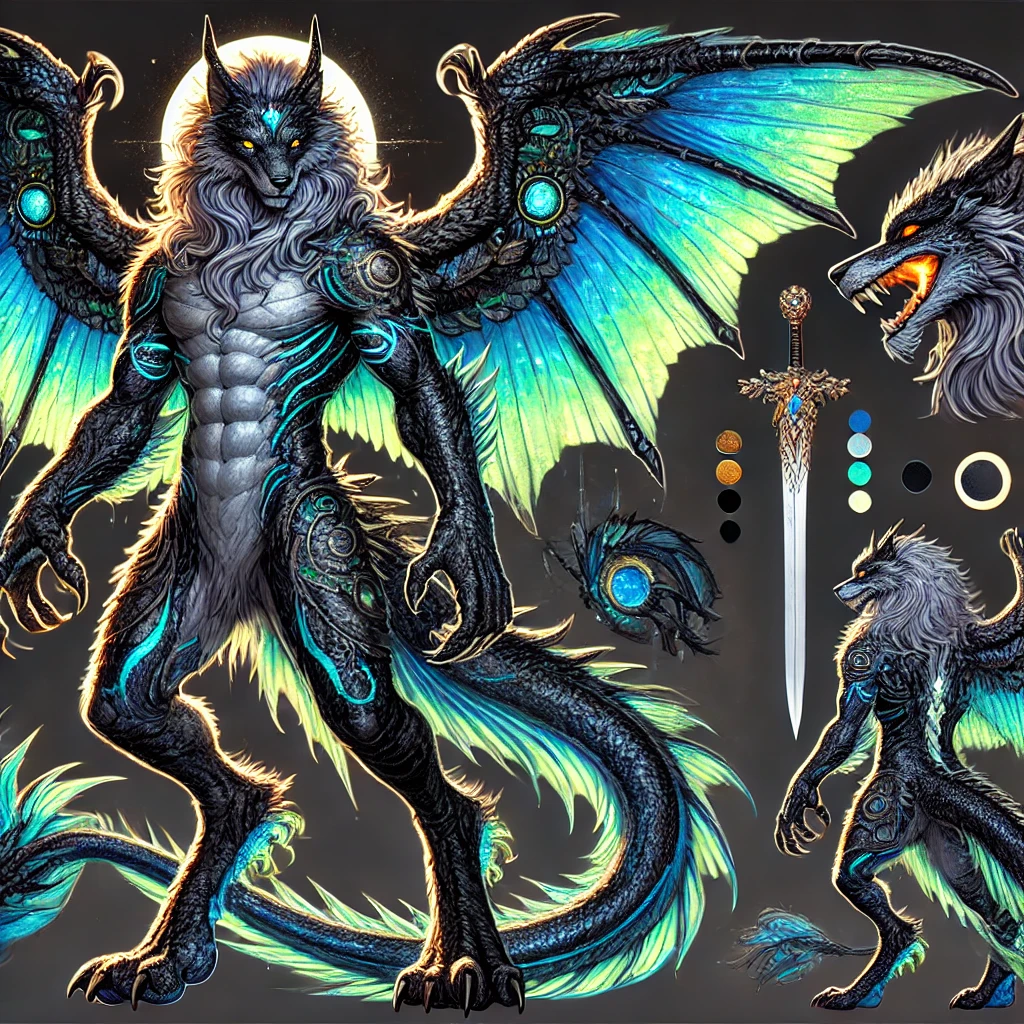
Skinwalker
Human to look at, and carrying every creature whose skin they have made their own.
Content note. This entry describes how skinwalkers take the skin from the bodies of the dead, sentient people included, to make the skins they transform with. It is written in the same register as the rest of the guide. The Making a morphoderm section is the one to skip.
Overview
Skinwalkers look human, and in their base form they are, near enough. What sets them apart is walker magic: the power to make a usable skin, a morphoderm, from any being that has died, and to become that being in almost every way by wearing it.
They are born to skinwalker parents, and the magic runs in bloodlines. They live in the Veil and on Earth alike, passing easily for human wherever they go.
Taking morphoderms at all is a choice. A skinwalker can live a whole life as a human and never make or wear a single one.
Physical traits
The base form is human. It is stronger, faster and more durable than an ordinary human body, and a skinwalker falls ill far more rarely.
Two signs mark a skinwalker who has absorbed morphoderms, and both show only on a closer look. Their skin carries faint patterns of the colouring and texture of each one, a pale trace of fur, scale or feather laid over their own. And their eyes flash with the colours of the eyes those morphoderms once belonged to. The more a skinwalker absorbs, the more visible both become, the patterns and the flashes layering one over another.
The third sign is in the hands. Beneath each fingertip sits a claw that is invisible until it extends. Extended, they are long and fine, delicate to look at, and very strong.
Making a morphoderm
A skinwalker can make a morphoderm from the body of any being that has died, whatever its kind, sentient people included. Whose skin a skinwalker takes, and why, is entirely their own.
They work with their claws and with tendrils of their magic together. As the claws free the skin, the magic forms a backing and attaches it, layer by layer, until the whole skin lifts away in one piece. The backing is clear, flexible and textured, with a firm, slightly rough grain beneath the hand. The skin has to come away whole to be usable, which makes the work slow and careful. Skill shortens it, and even the most skilled skinwalker takes several minutes at the very least. Once the skin is free, the rest of the body plays no further part.
A finished morphoderm carries the transformative power of walker magic, and it never decays. Any skinwalker can use it.
The morphoderm carries the body alone. The being’s memories stay behind with them.
Keying
A skinwalker who wants a morphoderm to be theirs alone binds a little of their own magic into it, keying it to themselves. A keyed morphoderm responds to no one else.
Keying can be undone, by the skinwalker who did it and by no one else, and only with a great deal of time and patience. The keying has to be drawn out without disturbing the transformative power beneath it, the power that gives the morphoderm its backing and keeps it from decaying, and that takes great care.
Transformation
To transform, a skinwalker touches a morphoderm, a hand on its fur, flesh, chitin or scales, and triggers its magic. The morphoderm lifts by itself, seamlessly, and wraps around them, shrinking or enlarging as it needs to. Their body flows through the change and becomes the creature, taking on every aspect of its anatomy and its magic.
How fast this happens depends on the skinwalker. One who is very powerful and very skilled can change in a second, and less power or less skill makes it slower.
A skinwalker becomes the creature in almost every way. Its innate instincts come with the morphoderm, so a skinwalker wearing a body they have never had before can walk, fly or swim in it at once. Its memories, knowledge and skills stay behind. A few things of the skinwalker’s own carry through as well: the faint patterning in the skin, the flashes of colour in the eyes, and walker magic itself.
Shifting back runs the same way in reverse. The body returns to its human form first, with the morphoderm still firmly in place, and only then does the morphoderm lift away from their flesh, ready to be set down until it is wanted again.
For someone else
A skinwalker can transform someone who is not a skinwalker, keyed morphoderm or not. They place the morphoderm around that person and activate its magic, and the person transforms fully, exactly as a skinwalker would. They stay that way until the skinwalker turns them back.
Absorption
A skinwalker carries morphoderms with them by absorbing them into their own body. They transform into the creature first, and then keep the change going until they are human again, holding onto the morphoderm with their magic the whole way. That layers it into their flesh, and it is the source of the patterns in their skin and the colours in their eyes.
They can absorb a morphoderm someone else made, so long as it is not keyed to another skinwalker. There is no known limit to how many they can carry.
Transforming into an absorbed morphoderm, the skin rises from beneath their own and wraps around them, and the change continues as usual. Shifting back from one begins the same way, the body returning to human form, and then the morphoderm sinks back beneath their flesh until only its pattern lies faintly on the surface of their skin and its colour faintly in their eyes.
Absorption can be undone. The skinwalker shifts into the creature, then releases the morphoderm from their power, and they return to their human form with the morphoderm left outside them, ready to be picked up again.
Partial transformation
An absorbed morphoderm can transform part of a skinwalker and leave the rest as it was: a hand into a dragon’s paw or a bird’s talon, fur or scales across the skin, a tail, a pair of wings. A morphoderm that has not been absorbed must be taken whole.
Injury and death
Injuries taken in another form carry over to the base form, and the morphoderm comes away untouched when the skinwalker shifts back.
The one exception is mending. A torn or damaged morphoderm is repaired by wearing it and giving the wound time to heal naturally. When the skinwalker shifts back, the morphoderm is whole again.
A skinwalker who dies in another form dies as that creature. Walker magic dies with them, and they do not change back.
Magic
Walker magic is an extra force, and every skinwalker carries it: the making of morphoderms, keying, transformation and absorption all belong to it.
Any other magic a skinwalker carries is their own. While they are fully transformed, walker magic and the morphoderm’s own magic are the only magic they have, and every other affinity they hold is blocked until they shift back. Whatever magic belonged to the creature is theirs to use only once they have transformed into it. In a partial transformation, that magic works only from or on the part of the body that has changed.
Ageing
Skinwalkers age to about twenty-five and then stop.
A skinwalker who stops using walker magic for many years begins to age normally again, and stops once more as soon as they return to it.
Shared instincts
Skinwalkers share walker magic and the strengthened human body beneath it, and nothing more. They have no instincts in common, and how any skinwalker uses their magic, if they ever use it at all, is entirely their own.
Where the name comes from
The English word skinwalker comes from Diné (Navajo) belief, the yee naaldlooshii. That belief is a living one, and we take nothing from it beyond the word.
Morphoderm is built from the Greek μορφή, morphē, shape or form, and δέρμα, derma, skin. Shape-skin is the reading.
Field notes
The morphoderms a skinwalker carries and how they look in each, how strongly their walker magic runs, whatever magic they hold of their own, and what they choose to make, key and absorb belong on each member’s own page.
Shared traits
- Where they live
- The Veil and Earth; they pass for human
- Base form
- Human; stronger, faster and more durable than a human, and rarely ill
- Signs
- Faint patterning in the skin and flashes of colour in the eyes from every morphoderm absorbed; fine, retractable claws beneath the fingertips
- Morphoderm
- A skin taken whole from a deceased being and given a clear, flexible backing; it never decays
- Keying
- Optional; binds a morphoderm to one skinwalker, and only they can undo it
- Transformation
- Full: anatomy, instincts and the creature's own magic; never its memories, knowledge or skills
- Absorption
- Carries a morphoderm beneath the skin; required for partial transformation; no known limit
- Magic
- Walker magic, an extra force; a full transformation blocks every other magic they carry
- Ageing
- Stops at about twenty-five, and resumes only after many years without using their magic
- Lineage
- Born, and carried in bloodlines
Members
-
Morphylax
A quiet skinwalker of thirteen shapes, every one of them held to keep the world safe.