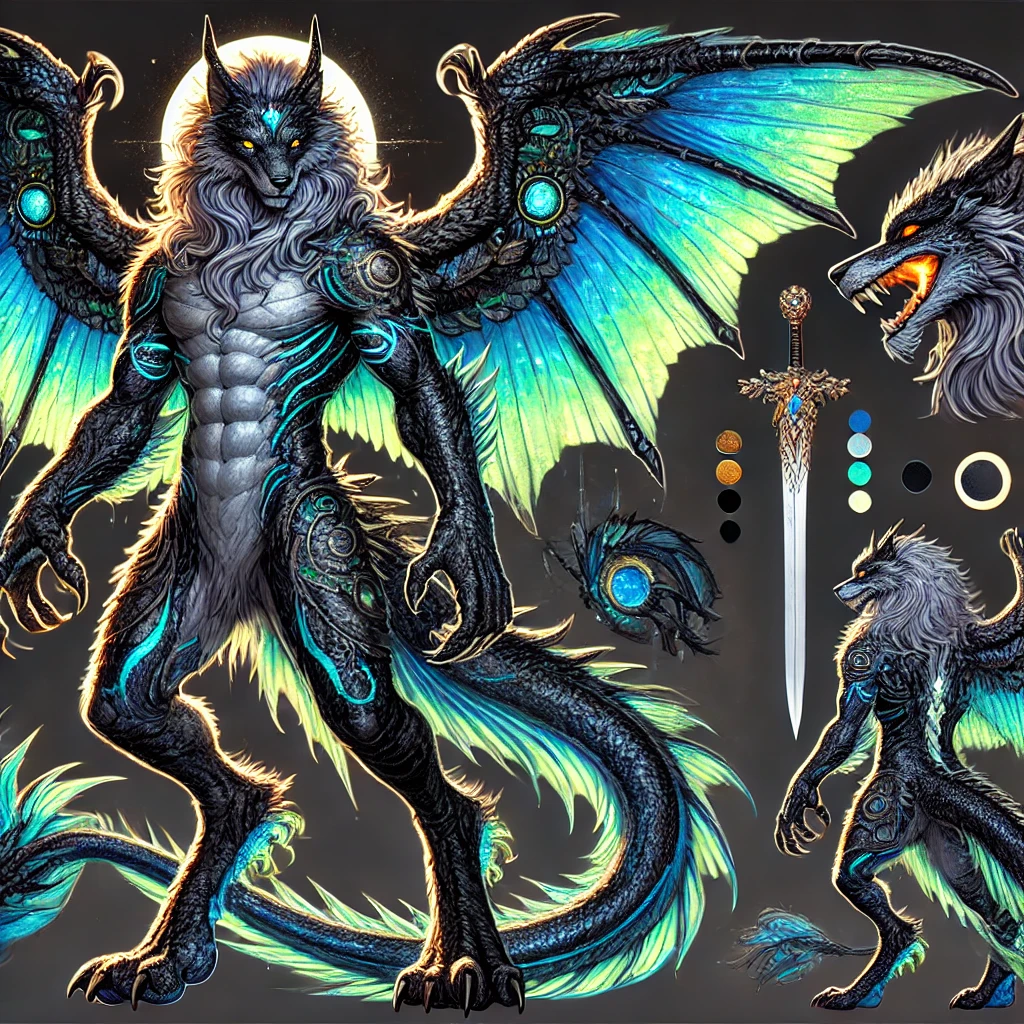
Plumaleon
Bear in the shoulders, lion in the haunches, wings of feathered fur — and a living substance flowing where a heart and lungs would be.
Overview
Plumaleon are large, winged, soft-bodied predators from a homeworld of their own. They carry a bear’s strength at the front and a lion’s grace behind, a pair of great eagle-shaped wings at the shoulders, and fur so thick that a hand sinks deep into them.
What fills that fur is vivoment, a living substance that takes the place of flesh, heart and lungs. It flows where a plumaleon wishes it, it heals quickly, and it carries strength well past what muscle allows. That gives the species its defining combination: remarkably soft and flexible, and remarkably strong.
They are born in the ordinary way and grow up like anyone else.
Physical traits
A grown plumaleon runs seven to ten feet long, and can stand as much as seven feet at the shoulder. They are as comfortable on all fours as they are upright, and move between the two freely.
The front of the body is a bear’s. The head is broad and heavy-built, with rounded ears and a bear’s muzzle, and it sits on a thick, powerful neck above wide shoulders. The forelegs are heavy and strong and end in broad paws. Behind the shoulders the body narrows and lengthens through the barrel into a lion’s waist, and the hindquarters and hind legs are leonine, made for springing. A lion’s long tail sweeps out behind.
The paws follow the same split, broad and bear-like in front and leonine behind. Their claws retract by softening back into the paw and firm again as they extend.
The fur is thick and soft all over. How long it grows, and where it is plushest, varies from one plumaleon to the next.
Wings
The wings are large and eagle-shaped, set at the shoulders. Each feather holds a feather’s shape and is made of the same fur as the rest of the body, filled through with vivoment, so the wings are as soft as everything else about a plumaleon. They fly fully, and fold flat against the body when not in use.
Eyes
A plumaleon’s eyes are each a single colour, unbroken from edge to edge, with no iris or pupil dividing them. They shine in the dark the way a predator’s eyes do, and they shift with feeling as readily as any other eyes, softening, widening and narrowing with whatever a plumaleon feels.
Vivoment
Vivoment fills a plumaleon from end to end. It is alive in every part, and each part keeps itself alive, which is why a plumaleon has no heart and does not breathe. Nothing needs to be pumped around the body or carried to it. They eat, drink and sleep, and the energy from food is taken up into the vivoment and spread through it directly, without any circulation.
What makes vivoment live is wild magic bound into the species’ biology. It belongs to every plumaleon from birth, as much a part of what they are as their fur.
The organs a plumaleon has are formed of vivoment too, and they heal quickly when damaged.
A plumaleon moves vivoment wherever they want it. They can shift weight and bulk from one part of the body to another, giving the chest more heft or lightening the wings. They can loosen it and become lighter and softer still, or compact it, drawing it close together until they are far more substantial and carry close to the weight a creature their size would be expected to have. They can also reshape their outline a little, broadening or slimming their build.
Strength comes from the vivoment as well. The limits that bind ordinary muscle do not apply to it, so a plumaleon body that yields under a hand also lifts, pulls and holds with great power.
Injury
Plumaleon can be badly hurt and can be killed, though it takes a great deal. A serious injury has to do significant damage and spill a large amount of vivoment from the body before it threatens a plumaleon’s life.
Tendrils
Hundreds of thin tendrils grow all over a plumaleon’s body, and on many, thousands. Each is soft, silky flesh with vivoment inside it, strong and flexible along its whole length. They rise from the skin when needed and lie flat beneath the fur when not.
The tendrils feel everything they touch. They grip firmly enough to lift and carry, and they work finely enough to write and to use tools. How far they reach varies by individual, anywhere from four feet to ten.
Magic
Every plumaleon carries strong will and thought affinities, two of the mental fundamental forces. How strong the affinities run at full stretch varies from one plumaleon to the next. Using them leaves no visible mark, no light or glow; only the effect shows.
How a plumaleon uses either affinity is their own, as is any magic they carry beyond those two.
Ageing
Plumaleon grow from child to adult over about twenty years, and then they stop. A grown plumaleon stays as they are, and old age never comes for them.
Shared instincts
The bear and the lion both carry into the species, as predator and as protector: the instinct to hunt, and the instinct to stand over what is theirs and keep it safe.
Those instincts are shared. Temperament is each plumaleon’s own.
Where the name comes from
The name is built from two roots.
Pluma is Latin for down, the soft, small feathers that lie closest to a bird’s body. It is there for the softness that runs through the whole species, and for wings that hold a feather’s shape while being made of fur.
Leon is the Greek λέων, leōn, a lion, for the grace of the hindquarters and the hunter’s instinct the species carries.
The downy lion is the reading.
Vivoment is built the same way, from the Latin vivus, living, and tomentum, the Romans’ word for the wool, feathers and hair packed into cushions and mattresses. Living filling, said outright.
Field notes
Individual colouring, the length and lie of the fur, eye colour, how many tendrils a plumaleon has and how far they reach, how strongly their will and thought affinities run, and whatever magic they carry beyond those two belong on each member’s own page.
Shared traits
- Origin
- A homeworld of their own; born in the ordinary way
- Size
- Seven to ten feet long, and up to seven feet at the shoulder
- Stance
- Equally at ease on all fours or standing upright
- Build
- A bear's head, neck, shoulders and forelegs; a lion's waist, hindquarters and long tail
- Wings
- Large and eagle-shaped, every feather made of fur and filled with vivoment; fully flighted and able to fold
- Eyes
- A single colour edge to edge, with no iris or pupil; they shine in the dark and change with feeling
- Vivoment
- A living substance filling the body and forming its organs; shifted, compacted or loosened at will
- Heart and breath
- Neither; every part of the vivoment sustains itself, and food is taken up and spread without circulation
- Tendrils
- Hundreds to thousands over the whole body; sensate, strong and fine-handed, reaching four to ten feet
- Affinities
- Strong will and thought, carried by every plumaleon; the full strength varies
- Ageing
- Adult at about twenty, and then no further; they do not die of old age
Members
-
Kikaze
A plumaleon who listens to the stories of the world, and shelters whoever cruelty has touched.