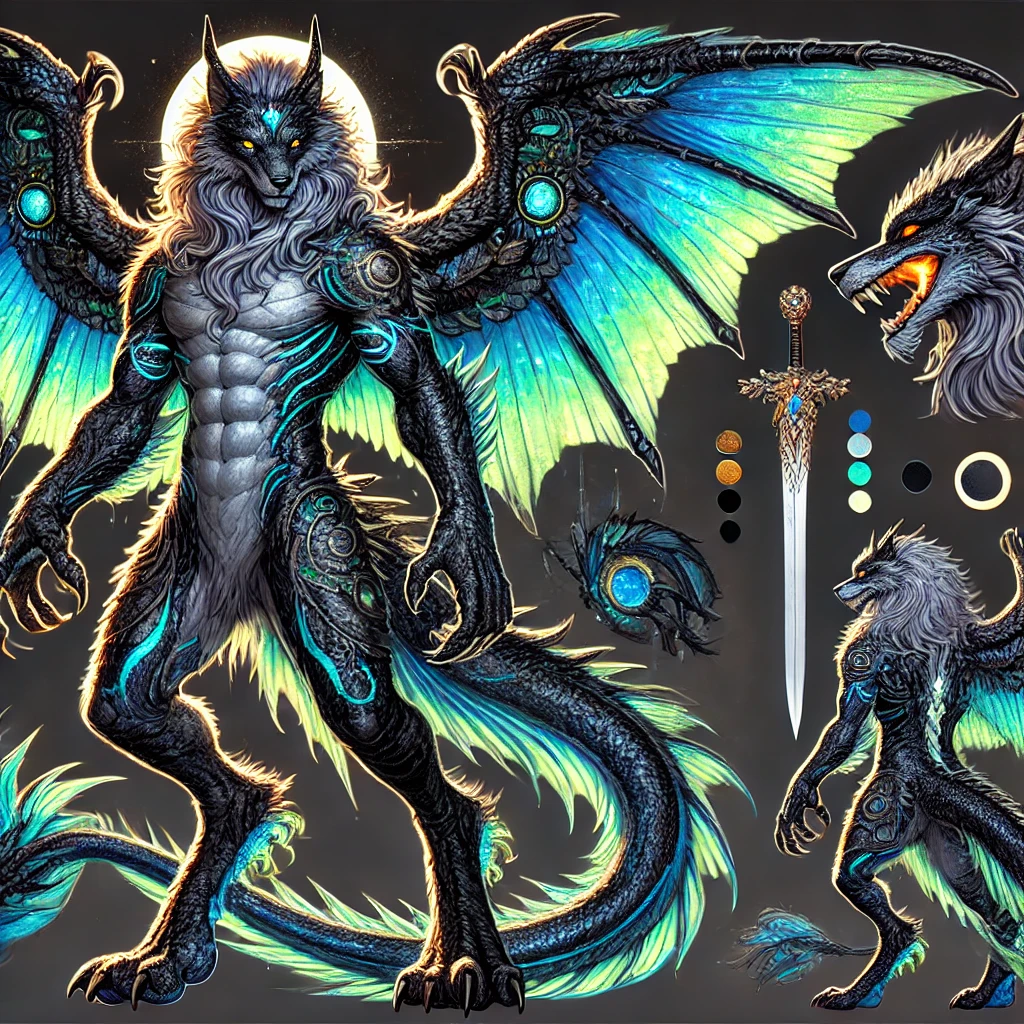
Syntheon
An apex predator built around implantation — and around keeping the host alive.
Content note. This entry describes syntheon reproductive anatomy and behaviour in clinical but explicit detail, including implantation into a living host, the sedative and arousing venom used during it, and the sexual contact that sometimes follows. It also notes that individual syntheon vary in whether they seek consent. If that is not something you want to read, skip to Magic.
Overview
Syntheon are apex predators, shaped into the role by long evolution on a homeworld of their own where they became exactly that. They stand over seven feet with a lithe, powerfully athletic frame in which most proportions read as built for hunting. The grace is real and it does not soften the capability.
Physical traits
Beneath retractable plating lies warm living skin — smooth, remarkably resilient, with a gentle elasticity comparable to dense natural rubber while remaining unmistakably organic. It yields under pressure and returns effortlessly, allowing extraordinary freedom of movement without sacrificing durability.
Under threat or exertion, dense protective plates emerge seamlessly across the body, overlapping into flexible armour that moves like muscle and restricts nothing.
Very little about the appearance is fixed. Build varies as much as it does in any other species — all syntheon are powerful predators, but they do not all look alike. Skin and plating colour both vary considerably by individual and by region, and the plating is not always bronze. Only two traits are genuinely static across the species: the iridescent shift in the skin, and the translucent edges of the plating.
The head is elongated, with a smooth cranial dome sweeping backward in a continuous curve that conceals most of the sensory anatomy beneath a translucent surface. Eyes sit partially veiled beneath it, softly bioluminescent. How expressive that gaze is depends entirely on the individual; some syntheon control their reactions far more tightly than others.
Powerful digitigrade legs carry the weight with near-silent footfall. Hands end in broad fingers with retractable claws beneath the same living plating. A long, fully prehensile muscular tail serves as counterbalance, climbing aid, expressive limb and weapon.
Jaws and inner anatomy
Set beneath the smooth features is a pair of powerful outer jaws lined with ivory teeth. Within them sits a precise inner jaw capable of extending with extraordinary speed and accuracy. It functions as a formidable weapon and is equally adapted to the biological functions specific to the species, its movements controlled with considerable delicacy.
Hidden within the inner jaw is a specialised set of tubes, and within the tongue a specialised organ. Both exist for implantation.
Reproduction
Implantation occurs through the organ in the tongue.
The syntheon seals its mouth over the host’s and breathes for them through the tubes in the inner jaw — the same structure that gently holds the host’s mouth open, so that neither the host nor the egg is harmed. A specialised venom is released directly into the host’s system through the tongue and inner jaw, producing a numbing, sedative and strongly arousing effect. The tongue then extends down the host’s throat, where the egg is carefully placed and attached to the heart, drawing on the host’s own energy to grow.
The venom’s effects last only a short time after it is fed in, so a constant pump is typically maintained throughout implantation — and often afterwards during sexual activity, should the host and the syntheon both want that.
A host can be any biological creature capable of supporting a life, though typically it is a species that does not lay eggs itself. Syntheon are the one exception to that, and carry for each other readily enough.
The host’s experience during implantation is very pleasant and intimate, and usually stays that way for some time afterwards. While the egg grows they can expect tiredness and a substantially increased appetite. The whole term runs anywhere from two weeks to three months, depending on the host’s strength — which determines how much energy the egg is able to draw at a time.
When the egg is ready to hatch it is removed through the same process in reverse. It cannot hatch inside a host, and if it stays too long it dies. Syntheon can sense when removal is due, through a hormone the egg releases into the host’s system as it nears maturity.
Host survival is a property of the biology, not a decision. The species evolved to preserve rather than consume, and that holds regardless of the individual’s intentions. It should not be mistaken for evidence of anyone’s character.
The offspring carries a relationship to both. Its base structure comes from the syntheon; everything else comes from the host. A syntheon born from a human and a syntheon born from a dog look very different from each other, and both parents remain connected to what results.
Consent
Among syntheon, seeking consent before implantation is a cultural norm. It is expected, and a syntheon who ignores it is breaking an understanding their society holds rather than acting within one.
The norm is not a guarantee. The biology that ensures a host survives ensures nothing whatsoever about whether they agreed, and individuals do break it. A syntheon who treats implantation as something requiring trust and willing agreement is meeting their culture’s expectation; one who does not is a real possibility, and the species neither prevents it nor excuses it.
Magic
The species fixes nothing about magic. Everything about implantation, the venom and the plating is biology. Whether a given syntheon is tied to magic, and how, is their own.
Shared instincts
Syntheon are relational by instinct, understanding connection through shared experience, physical closeness and sustained action rather than through declaration. Touch matters a great deal to them as a species. Whether a given syntheon expresses that through the tail or through the hands is their own choice, and the constant unconscious tail contact often described of them belongs to Symtheron rather than to syntheon generally.
Beyond that they share the predator: immense strength, exceptional resilience, and instincts honed across generations.
They do not share a disposition. Syntheon are fully sentient people, which means they are just as capable of fear and uncertainty as they are of confidence and certainty, and how much self-control any of them exercises is individual.
Field notes
Individual colouring, plating tone, build, expressiveness and disposition belong on each member’s own page.
Shared traits
- Origin
- Evolved as apex predators on their own homeworld
- Build
- Over seven feet; lithe and powerfully athletic, and varying widely by individual
- Static traits
- Iridescent shift in the skin; translucent edges to the plating
- Armour
- Retractable plating emerging seamlessly from living skin; colour varies
- Reproduction
- Implantation into a living host; host survival is guaranteed by the biology
- Offspring
- Base structure from the syntheon, everything else from the host
Members
-
Symtheron
A syntheon who says most of it by staying, and very little of it aloud.