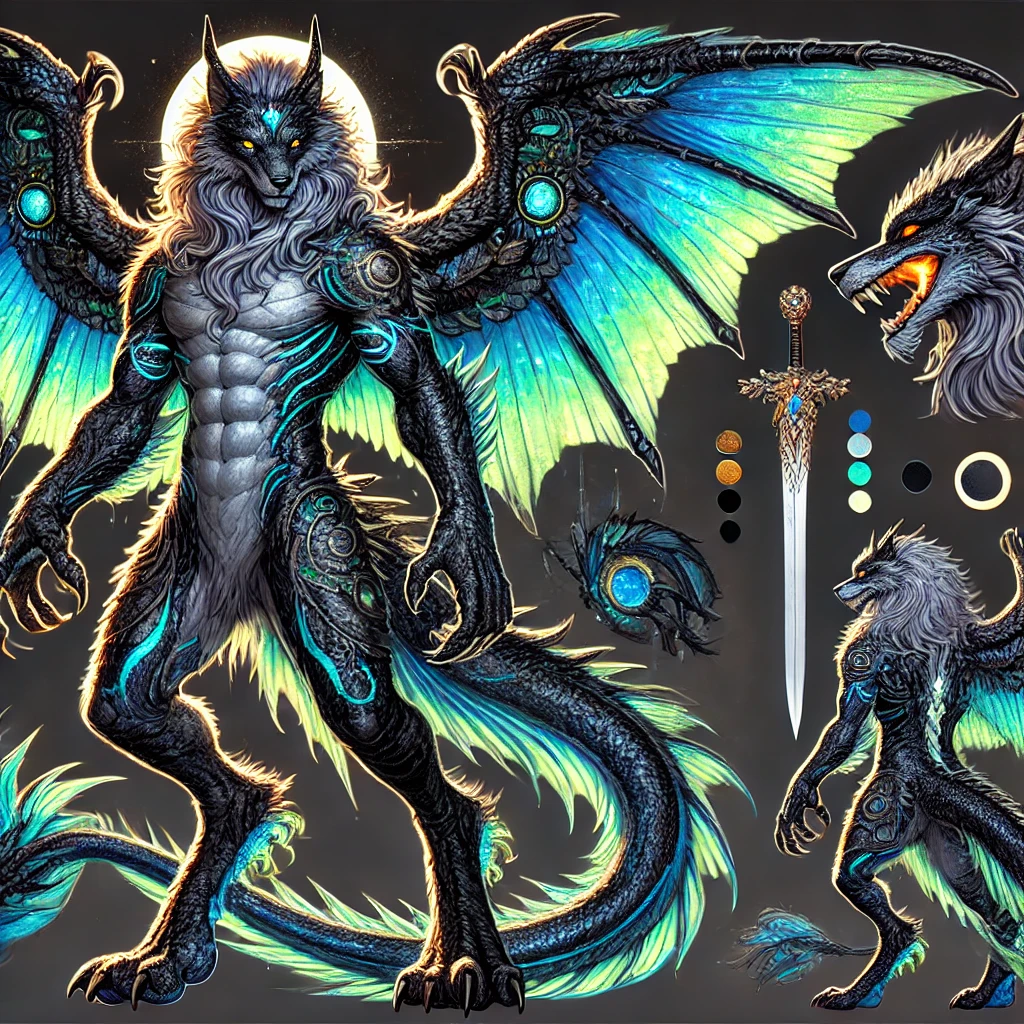
Harpy
Wings, talons and a beaked mouth on a humanoid frame — and a gaze that keeps hold of you after it looks away.
Content note. This entry describes the harpy gaze, which is a form of mind control, can be used on someone who has not agreed to it, holds indefinitely, and is pleasant to be under. The gaze is the section to skip.
Overview
A harpy is a humanoid built to a much heavier scale, carrying a pair of feathered wings, a layer of armour beneath the skin, and a gaze that stays with whoever it catches.
They were born on Earth and live in the Veil now, as the magical species that originated here do.
There are no harpy breeds. What varies, varies by individual.
Physical traits
Harpies run from around six feet to around twelve, and where any of them falls in that range is their own.
The mass is the part the height understates. A harpy is flesh and bone throughout, built heavy the whole way — thicker bone, deeper muscle, a frame laid out for the weight it carries — so a harpy standing level with a person outweighs them by a very wide margin. In mass they sit far closer to a dragon than to anything human-shaped.
The wings are a separate pair, rising from the back and feathered along their length, and each one is tipped with a claw. Below them the arms are ordinary humanoid arms, and the hands are humanoid hands with claws on the fingers.
The legs are digitigrade and built like a bird’s the whole way up, ending in taloned feet.
The face is humanoid, carrying a beaked structure through the mouth and jaw. It leaves speech entirely alone — a harpy talks the way anyone else does. What it adds is a register nothing with an ordinary mouth has: a harpy can clack their beak, and they do.
The head carries hair, not feathers. The skin is bare, and its colouring, along with the colouring of the feathers, comes down to the individual.
Flight
Harpies fly, and the wings are what does it. Weight makes no difference to that, and the flight is unremarkable in the same way a Lunari dragon’s is — a heavy body carried by a wingspan built to carry it.
The scales
Every harpy carries a full layer of scales folded away beneath the skin and muscle, covering the whole body.
Down, they are undetectable. A hand run across a harpy’s skin finds skin, with nothing underneath to give them away. Up, they are armour, and the change between the two states is quick and entirely smooth — the scales rise through, settle into place, and the body carries on as it was.
Raising them and lowering them is a decision, made as often as a harpy cares to make it.
The gaze
A harpy’s gaze channels magical hypnosis, the same extra force a kitsune puts out as foxfire, a lamia delivers through the gaze and a kraken carries in the voice.
It is used by choice. A harpy looking at someone is looking at someone, and the hypnosis is something they reach for when they want it.
Whoever cannot see it is untouched by it, the same way the kraken voice passes over someone who cannot hear. Resisting it is mostly futile unless the person resisting is exceptionally strong-willed — which is true of every version of this force, and true of the harpy’s no more and no less. It is unfailingly pleasant to be under.
What the harpy’s version does differently
The hold outlasts the look. Every other channel of this force runs while the channel runs and ends when it ends; a harpy’s ends when the harpy decides it ends. Eye contact is how it arrives and has nothing to do with how long it stays, so a harpy can catch someone, look away, leave the room, and the hold goes with them.
Two things break it.
The harpy letting go. They can release someone at any moment, for any reason, and it is as ordinary a decision as catching them was.
Distance. The hold reaches about three miles and gives out past that. Whoever gets far enough away comes out from under it on their own.
Ageing
Harpies grow until roughly the human age of twenty-three, and then they stop.
After that they simply keep going. A harpy does not die of old age.
Magic
One thing is fixed: the gaze. Every harpy carries it, and how strongly belongs to the individual.
Everything else is individual as well. Whatever a harpy is tied to magically beyond the gaze is theirs alone.
Shared instincts
Harpies share the body plan with its wings, beak and claws, the scales, the gaze, the size and mass, and the ageing pattern. That is the list.
They do not share a temperament, and the word arrives carrying an unusually loud one — shrieking, filthy, snatching things away and fouling what it leaves. That is a description of a story, and a late one at that. A harpy may be quiet, or funny, or exacting, or easy company over a long afternoon, and how any of them carries themselves is their own.
Where the name comes from
Harpy comes from the Greek Ἅρπυιαι, Harpyiai, built on ἁρπάζω harpazō — to snatch, to seize, to carry off. The oldest of them are wind: in Homer they are the gusts that take someone and leave nothing to bury, and in Hesiod’s Theogony they are Aello and Ocypete, daughters of Thaumas and Electra, “lovely-haired” and as swift as birds and as the winds themselves.
The version most people carry came later. Apollonius and then Virgil made them bird-bodied, women-faced and foul, tormenting the blind king Phineus by snatching his food and spoiling whatever they could not carry, until the winged sons of Boreas drove them off. Dante set them loose in the wood of the suicides in Inferno XIII, and the English word settled into an insult somewhere along the way.
All of that is background here and none of it is load-bearing. What we have in common with it is wings and a shape. The storm spirit, the snatcher, the tormentor and the insult are recorded because the name came from somewhere, and they say nothing about what a harpy actually is.
Field notes
Individual size, skin and feather colouring, hair, wingspan, the look of the scales when raised and how strongly a harpy carries the gaze all belong on each member’s own page.
Shared traits
- Origin
- Earth-born; now in the Veil
- Body
- Humanoid, with a separate pair of feathered wings and digitigrade bird legs
- Size
- Six to twelve feet, by individual
- Mass
- Flesh and bone built heavy throughout; closer to a dragon's mass than a person's
- Face
- Humanoid, with a beaked structure to the mouth; speech is unaffected
- Scales
- A full-body layer of armour folded beneath the skin, raised at will
- Gaze
- Magical hypnosis, used by choice — and it holds after the looking stops
- Range
- The hold breaks at roughly three miles, or whenever the harpy lets go
- Ageing
- They grow to about twenty-three and stop; they do not die of old age
Members
No members recorded yet.