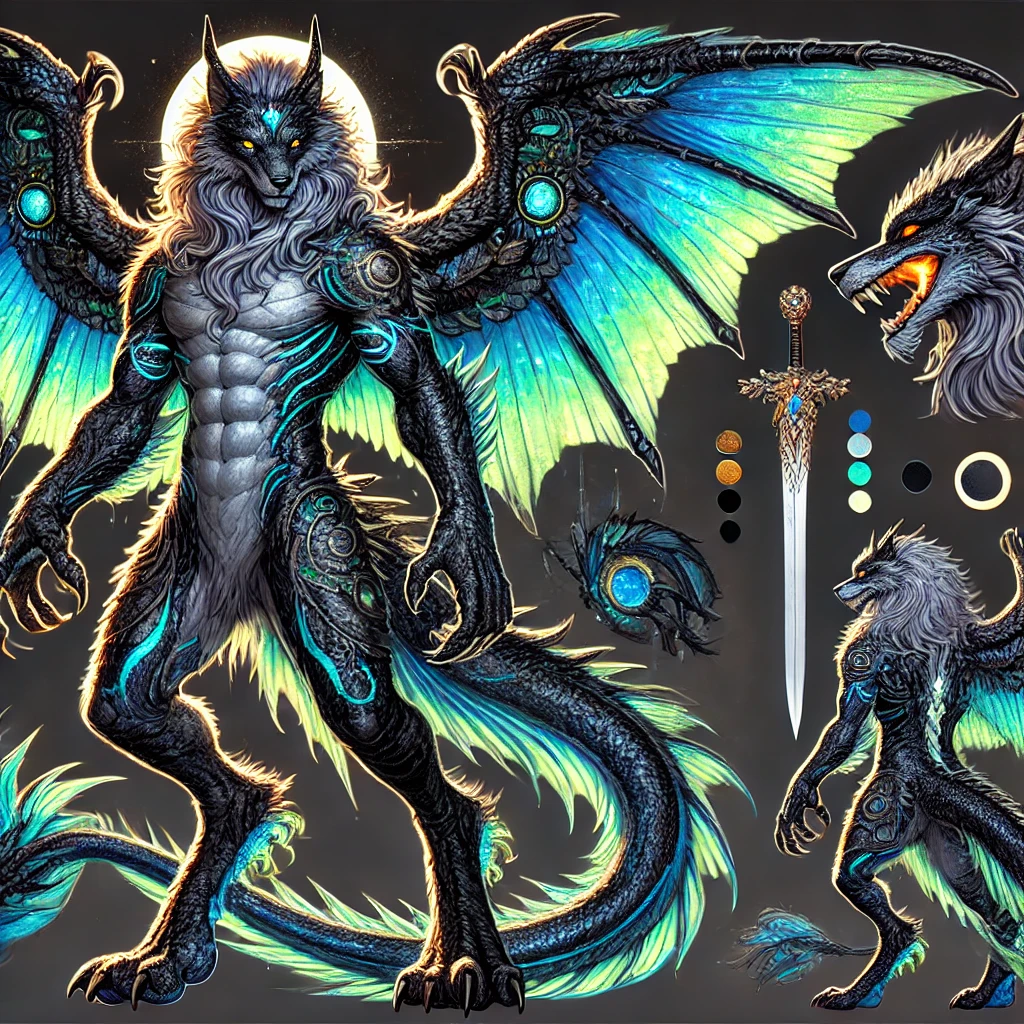
Gargoyle
Living stone that can harden into something almost nothing will break.
Overview
Gargoyles are living stone. They were born here and they live in the Veil now.
They eat and they sleep like anyone else. They grow to a point and then stop, and nobody knows quite why or what determines when — it varies from one gargoyle to the next.
Those with wings can fly. Plenty have them; it is not universal.
They come in far too many forms to list, and there is no useful breed division to draw.
The stillness
A gargoyle can harden into a statue. In that state they are very nearly indestructible and completely immobile, and they can remain alive with no sustenance at all for centuries.
It is a capability and nothing more. It is not a compulsion, not a requirement, and not something that happens to them on a schedule. A gargoyle does it because they have decided to.
The version of this from twentieth-century fiction — waking at night, turning to stone at dawn, bound to a daily cycle — is not how it works here. Gargoyles sleep like any other creature.
Magic
Two things are fixed, and they are different kinds of thing.
Control over the element of earth is a fundamental affinity, and every gargoyle has it.
Control over their own substance — the hardening, and the stone itself — is an extra force. Gargoyle stone is considerably stronger than ordinary stone and capable of deflecting many types of magic, which is not something a material should be able to do, and is exactly the sort of rule-breaking that puts a power in the extra category.
Everything beyond those two is independent and belongs to the individual.
Shared instincts
Gargoyles share the living stone, the hardening, the earth affinity and the growth pattern.
They do not share a temperament. Verathor’s steadfastness and his warmth are his own, and they are not a description of what a gargoyle is.
Where the name comes from
The word comes from French gargouille, throat, sharing a root with “gargle” — the noise of water passing through. In medieval architecture a gargoyle was a carved stone waterspout, throwing roof runoff clear of the walls so it did not wash out the mortar. Strictly, a carving with no spout is a grotesque rather than a gargoyle; the famous Notre-Dame figures are grotesques added in the nineteenth century.
We take almost nothing from that. The drainage function, the architecture, the whole business of being a decorated piece of plumbing — none of it is what a gargoyle is to us. What we keep from the older tradition is the stone composition and the ability to stand motionless for centuries.
Everything else comes from the modern reading instead: gargoyles are animate, living beings in their own right, not architectural fittings dressed up as creatures.
Field notes
Individual form, stone type, colouring and whether a gargoyle has wings belong on each member’s own page.
Shared traits
- Origin
- Born here; now in the Veil
- Composition
- Living stone
- Hardening
- An extra force — their stone deflects many kinds of magic
- Earth
- A fundamental affinity, carried by every gargoyle
- Stillness
- A capability: statue-still and near-indestructible, alive for centuries without sustenance
- Forms
- Far too many to list
Members
-
Verathor
A gargoyle who is difficult to move, and has never needed to prove it.