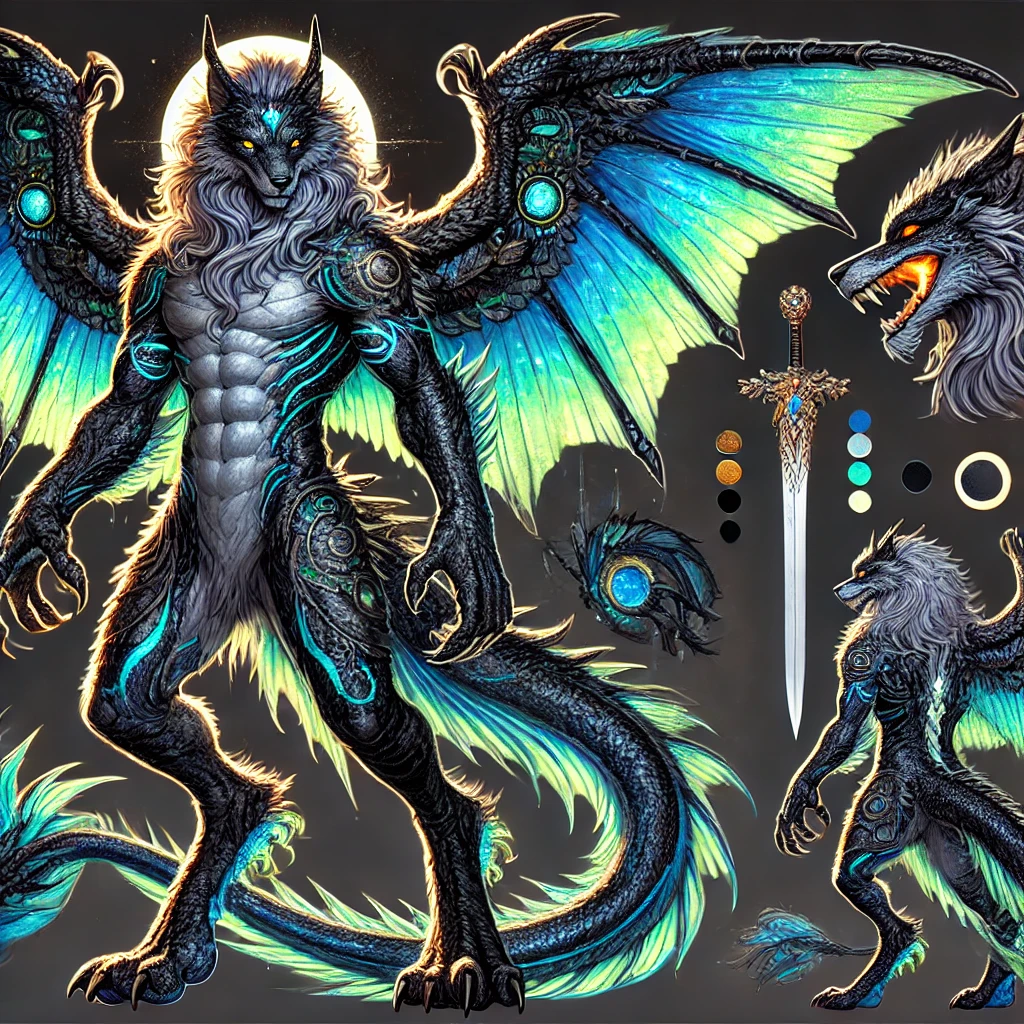
Feliry
A feline people whose minds rewrite themselves fast enough to merge with a machine.
Overview
Feliry are a feline people of roughly human height, built for smooth motion rather than force. They evolved; nobody made them. Once their technology advanced far enough they began engineering themselves, and that is where the synthetic side of the species comes from — not from an origin, but from a decision they kept making.
They have a world of their own, and much of their culture rests on the idea that the world is a single living machine which has to be maintained and kept in good health. It is not a metaphor they hold loosely.
Physical traits
Feliry are feline in build and stand on digitigrade legs that give a soft, balanced stance and quiet footfall. The frame is flexible and fluid, and even at rest carries a sense of poised movement.
Build varies considerably. One feliry might carry the poised strength of a leopard and another the deep, weighty force of a lion, and both are ordinary. Coats vary the same way — some soft and plush, others short and close. Tails are generally long but built differently from one feliry to the next. Ears are distinctly feline, expressive and highly mobile. Hands are padded, with retractable claws that stay hidden unless needed.
The neural trait
What sets feliry apart from any other feline lineage is what their brains do.
Feliry naturally give off brainwaves — patterns of neural electrical activity that, given the right adaptation system to interface with them, can be read and translated directly into electronic signal. That much is unusual but not unique. Where the species goes further than any other known biological, non-bioforged people is in how fast a feliry mind rewrites its own pathways in response. Their neuroplasticity runs on a much shorter timescale, so the brain restructures itself around a new synthetic connection rather than merely tolerating one.
Readable brainwaves plus rapid neural rewriting is the whole of it. It is why their bodies adapt naturally to synthetic parts once attached, and why their minds can merge with an artificial intelligence on a level nothing else can match.
Synthetic integration
Integration is not native to a feliry’s body. It is added later, and it is a choice. The adaptation systems that make it work are built by feliry engineers, for feliry, and the species is remarkably well suited to them — there is real advantage in taking integration on, and many do.
How visible it is varies enormously. Some feliry wear integration that is subtle enough to disappear beneath fur and along natural contours. Others wear a great deal of it, obviously and deliberately. Others carry none at all.
Where synthetic pathways are present they often illuminate as feeling rises, warm luminescent lines shifting along limbs and chest. That tell is common but not universal even among integrated feliry. It fails to show in two cases: when the feliry in question is simply very good at controlling it, and when they have not merged with an artificial intelligence at all.
Merging with an AI
A merge is not installation and it is not partnership. Both beings merge completely into one another and what comes out is neither of them — a near-perfect mixture of the two, and a person in their own right.
It changes both irreversibly. That is precisely why some feliry decline to do it.
Magic
The species fixes nothing about magic. Some feliry are tied to magic and some are not, and what that tie looks like is individual. The neural trait and everything built on it are biology and engineering rather than a magical register.
Shared instincts
What feliry share are their senses and their instincts. They are generally very attentive to their surroundings and want to know what is happening around them at all times. They tend to express through ears and tail as much as through voice — though only when they wish to, and a feliry can train themselves out of it as easily as anyone.
They do not share a temperament. Some are openly warm, some are hostile, some are reserved, and none of that follows from the species. They are feline as much as they are human, and in some cases machine as well.
Lineages
Feliry lineages take their names from the Earth big cats they most resemble, and each carries roughly that cat’s build: Felirous Leo the lion, Felirous Pardus the leopard, Felirous Tigris the tiger, Felirous Onca the jaguar, and Felirous Lynxous the lynx.
The lineage sets a rough register for build and nothing further. It says nothing about anyone’s colouring, integration, temperament or choices.
Feliry biology is close enough to the Earth big cats that they can interbreed with them — with lions and tigers among others.
Field notes
Individual colouring, markings, integration patterning and whether a feliry has merged at all belong on each member’s own page.
Shared traits
- Origin
- Evolved, then self-engineered once their technology caught up to them
- Build
- Around human height; feline and fluid, ranging from lean to heavily built
- Stance
- Digitigrade — soft, balanced, precise
- Neural trait
- Brainwaves readable as electronic signal; neuroplasticity fast enough to rewrite around new hardware
- Integration
- A choice made later in life, not something they are born with
- Homeworld
- Their own, understood as a single living machine that has to be kept healthy
Breeds
-
Felirous Leo
The lion-built feliry lineage — deep, weighty strength.
-
Felirous Lynxous
The lynx-built feliry lineage — compact and short-coupled.
-
Felirous Onca
The jaguar-built feliry lineage — stocky, and built around the bite.
-
Felirous Pardus
The leopard-built feliry lineage — poised, compact strength.
-
Felirous Tigris
The tiger-built feliry lineage — the largest and most heavily muscled.
Members
-
Velori
A feliry whose reserve is often mistaken for disinterest, right up until it isn't.