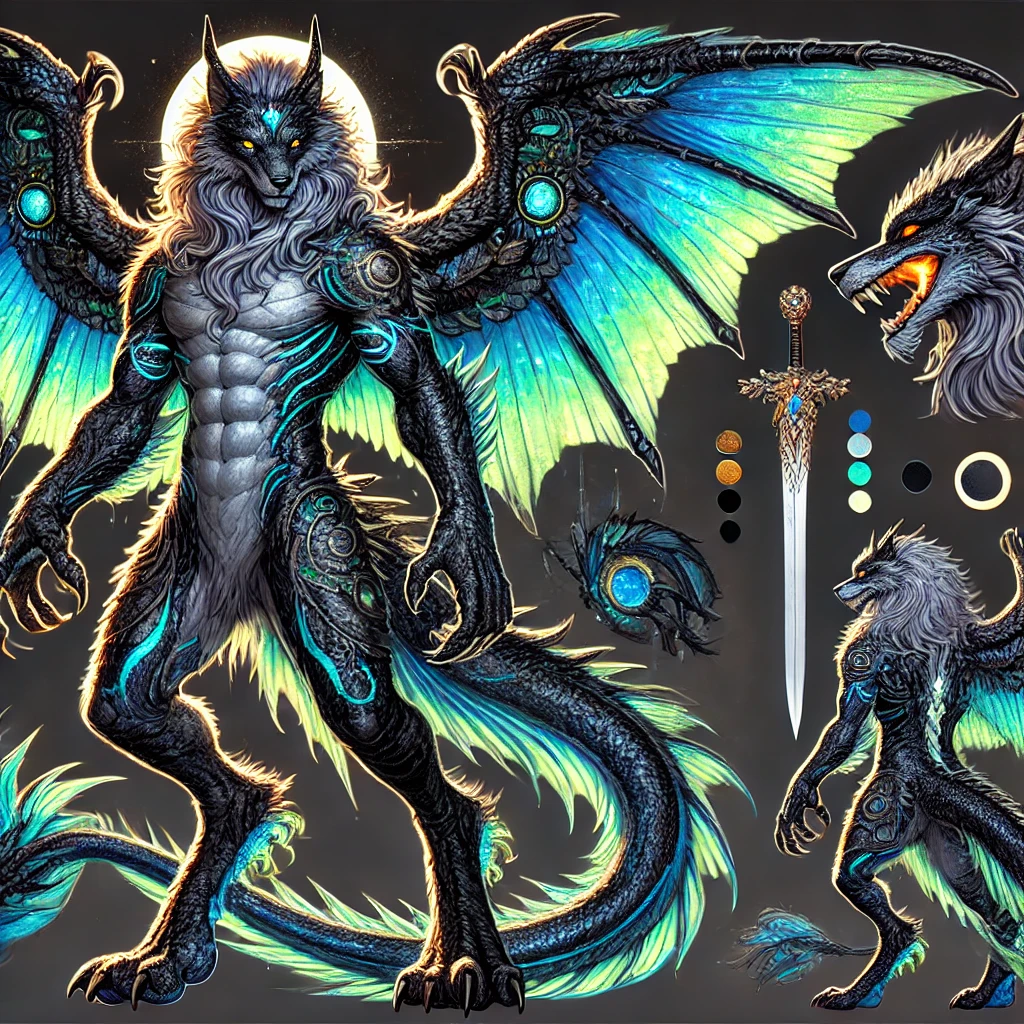
Leviathan
Serpent and swimmer, web-pawed and equally easy on land — carrying water and kinetic magic both.
Overview
Leviathans are a serpentine people of the water, and they walk out of it as readily as they move through it. Length is the through-line of the body, and four large webbed paws carry them across the seabed and across open ground with equal ease.
They live in the watery parts of the Veil. That is home, and it is where most of a leviathan’s life happens, though very little about them is confined to it.
There are no leviathan breeds. What varies, varies by individual.
Physical traits
The body runs long and sinuous, scaled throughout, with a build arranged around the whole length of it rather than around a torso and limbs. Colouring and scaling both come down to the individual.
The paws are the detail worth pausing on. They are large, broad and fully webbed, closer to an oversized otter’s paw than to a flipper, with the toes and the structure behind them intact. That is exactly why land costs a leviathan nothing — the same paw that drives them through water carries their weight on a riverbank, and neither use is a compromise made for the other.
Size runs from around seven feet to around thirty, and where any leviathan falls in that range is their own. It also moves with the form they are holding, so a leviathan’s length is a fact about the shape they are currently in as much as about the person in it.
The range
A leviathan’s body sits anywhere between the full serpentine form and a nearly human one, and moving along it is native to the species.
The human end of the range keeps the scales and keeps the webbing between the fingers and toes. A fully human form sits outside what a leviathan carries; nearly human is where the range ends, and it ends there for all of them.
Every point along it is equally the leviathan themselves, the same way it is for a kitsune, a jorōgumo or a gumiho. This is genuine shifting, and no one of the shapes along the way is the true one with the others worn over it. A leviathan holds whichever point suits them, for as long as it suits them.
Magic
Two things are fixed, and every leviathan carries both.
The first is water. The second is kinetic, one of the two physical fundamental forces and the equivalent of telekinesis.
Both are ordinary fundamental affinities. What is unusual is only that the species hands over two of them rather than leaving the question to the individual — how strongly a leviathan holds either one is very much theirs, and the two do not have to run at the same strength in the same person.
Everything past those two is individual. Whatever else a leviathan is tied to magically belongs to them alone.
Ageing
Leviathans age much the way dragons do. They grow, and at some point they stop, and when that happens depends on the individual.
After that they simply keep going. A leviathan does not die of old age.
Lineage
Leviathans and Solari dragons share a root, and it is a very distant one. The two diverged a long time ago and have kept diverging since, and the resemblance between a long serpentine dragon and a long serpentine leviathan is the last of what is left of it.
Nothing about the dragon system carries over. A leviathan has no bloodline element, does not channel through the breath, and does not channel through the tail.
Shared instincts
Leviathans share the body, the paws, the range, the two affinities and the ageing pattern. That is the list.
They do not share a temperament, and the word arrives carrying one — vast, slow, ancient, and looming somewhere under the surface. That is a description of a story rather than of a people. A leviathan may be quick, or loud, or small for their kind, or perfectly ordinary company on a riverbank, and how any of them carries themselves is their own.
Where the name comes from
Leviathan (Hebrew לִוְיָתָן) appears across the Hebrew Bible as a sea creature of enormous scale: described at length in Job 41, crushed in Psalm 74, and named in Isaiah 27:1 as “the fleeing serpent… the dragon that is in the sea”. Behind that sits the older Ugaritic Lōtān, a seven-headed serpent of the Baal Cycle, defeated in the same register. Later Christian demonology took the name in a different direction, and Binsfeld’s 1589 classification lists Leviathan among the seven princes; Hobbes borrowed it again in 1651 for the commonwealth itself.
We take some of the form and some of the powers. The chaos-serpent, the adversary waiting to be defeated, the demon prince and the political metaphor are all left where they were found, and none of them has anything to do with what a leviathan is here.
Field notes
Individual colouring, scaling, size, where along the range a leviathan usually sits and how strongly they carry either affinity all belong on each member’s own page.
Shared traits
- Origin
- The watery parts of the Veil
- Body
- Largely serpentine, with four large webbed paws built for walking as well as swimming
- Range
- Serpentine through nearly human, natively; any point held at will
- Size
- Seven to thirty feet by individual, and shifting with the form held
- Magic
- Water and kinetic, carried by every leviathan; how strongly is individual
- Kin
- A very distant root shared with Solari dragons
- Ageing
- They grow, then stop; they do not die of old age
- Breeds
- None; variation is individual
Members
-
Galenora
A leviathan who steps into the way early, and rarely needs anything more than that.