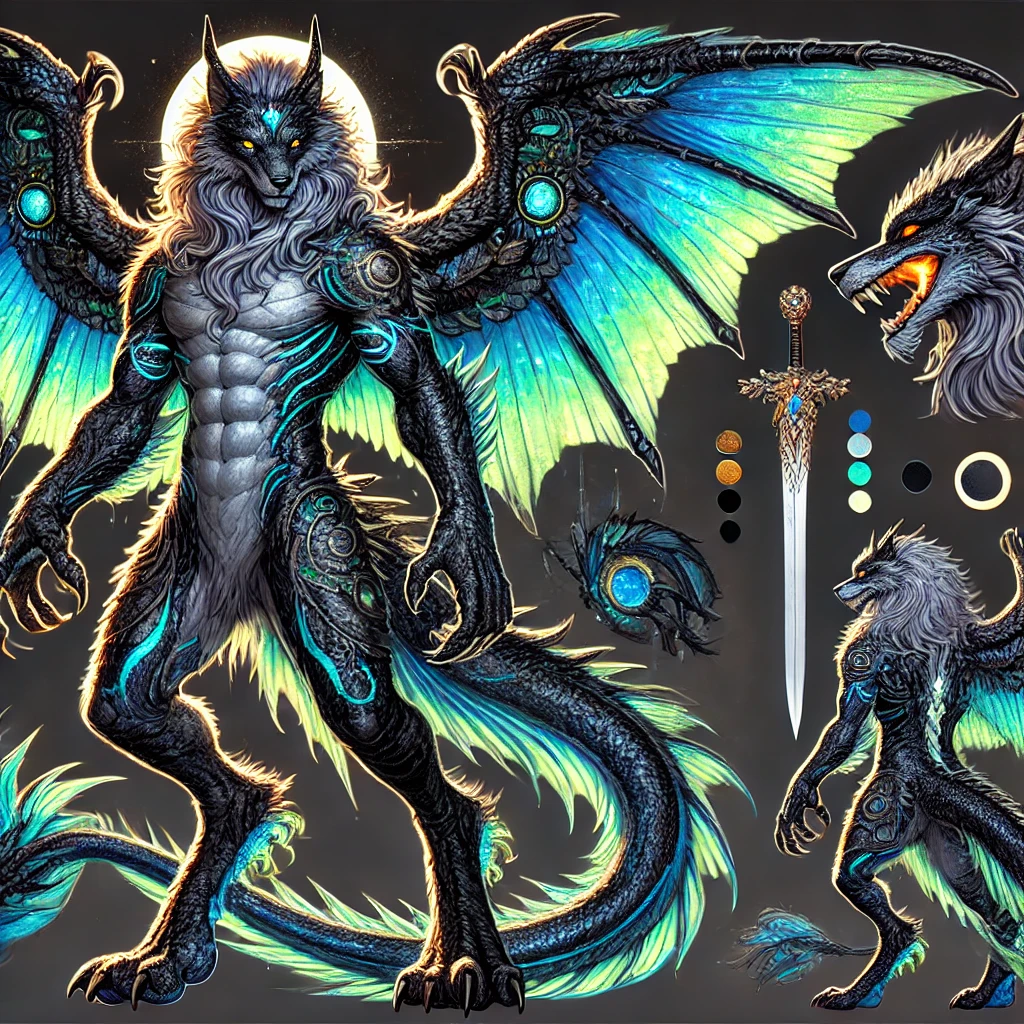
Talcoryn
A Metallurgist dragon whose theatre is genuine all the way down — and never once built to lie.
- Gender
- Male
- Pronouns
- he/him
- Species
- Breed
Name
Tal comes from the Sanskrit तال, tāla — the rhythmic cycle a piece of music or dance is kept in. It takes its own name from tala, the palm of the hand, because the measure is something clapped out.
Cor is the Latin cor, cordis: heart.
Ryn carries focused will — devotion that has settled into something steady and stopped being open to discussion.
The heart that keeps the rhythm is the reading. The performance and the compassion are the same thing in him, and the ending names what he values most: keeping time and keeping his word turn out to be the same verb.
Temperament
Talcoryn performs. It is the first thing anyone meets and it goes all the way down — the theatre is genuine, and he is at home inside it in a way that becomes obvious the moment he starts.
He does it for two reasons at once. He knows exactly how ridiculous he is being, and he is being ridiculous on purpose, because a room lightens when somebody is willing to play the fool in front of it. And he does it because he loves it. Take the audience away and he would still be doing most of it.
His humour is dry, and it works against the performance and alongside it in equal measure — a sweeping entrance closed out with a flat remark, or a grand statement he undercuts himself before anyone else gets the chance. It is also simply how he talks when nothing is happening. The wit is sharp and the intent behind it never is; he does not aim it at people, and on the rare occasion something of his lands harder than he meant it to, it genuinely wrecks him for a while.
The compassion takes longest to reach. People meeting him get the spectacle and frequently stop there, and the softer thing underneath goes unnoticed for a good while. It surfaces as a room empties. The fewer people there are the quieter he gets, and one to one he is a considerably gentler dragon than the spectacle suggests.
He values trust above nearly everything. His theatre is enormous and it is never once used to mislead anyone, and he holds other people to the same line he holds himself to. Deception reaches him as sadness first — he is hurt by it well before he is angry about it — and the anger arrives second and arrives properly. Deception aimed at someone he loves skips the first step.
He puts himself in front of people. Whatever is coming, he will be standing between it and his family, and he will be laughing while he does it, and almost nobody ever sees what that costs him. He has decided it is not theirs to carry.
He makes things. When he wants quiet, or when a stretch of time arrives with nothing already in it, he works metal — and it is the one thing he does with nobody watching.
Physical description
Talcoryn is a great deal of dragon, and warmth is what arrives first — before the size registers, before the metal does, before anyone has finished working out what they are looking at. He is impossible to overlook and remarkably easy to be near, and those two facts sit together in him without any tension at all. People are comfortable around him long before they understand him, and he is in no hurry to correct that. Whatever he is, he is plainly unimpressed by it.
He is the most heavily built dragon here, broad through the chest and shoulders and long through the body, with every proportion running a shade larger than it strictly needed to. The weight is worn easily. Size is ordinary for a Metallurgist and he treats it as ordinary — it has never slowed him, and what it has actually done is make him stronger. Underneath the bulk he is athletic, solid through the core and light on his feet, and the heavier plating across his chest, shoulders and spine reads as armour that was never put on.
His scales are organic metal, laid in overlapping layers like something assembled by hand. The finish is brushed and matte, so light crosses him in a moving line and never breaks into a flash. The surface carries a slight roughness, and the marks in it suggest a forge right up until they are looked at closely. They are grain. They run the way grain runs in old stone and weathered wood, and they arrived with him. He is faintly warm to the touch, the way worked metal stays warm long after the work has stopped.
The base metal is blackened iron, dark nearly to black, with heat colours living underneath it and surfacing wherever the light is right. Over the rest of him it is copper, deep and going toward red in every shadow it falls into. Along his spine, the ridge behind his skull and the leading edges of his wings the metal runs brighter, and those are the lines that catch when he moves — which he is entirely aware of.
Worked into the plating are patterns he engraved himself. They are fine, deliberate and unfinished, because he keeps adding to them; a plate he etched a long time ago sits alongside one he started recently and has not decided how to close. The work is his own, and it is one of the few things on him he will not talk about at length.
He carries fire and storm both, and the metal is where they show. His plating runs warm at all times, comfortable and never painful, and currents of fire move through it visibly — gathering, running, pooling until stretches of him look molten. They never come anywhere near it. The heat is a colour travelling under the surface and it stays a colour. The storm shows at his edges instead: flashes of electricity travel the rims of his scales and the trailing edges of his wings, brief and bright and going wherever they please. Anyone with a hand on him is simply not touched by them. They arrive where he wants them to arrive and nowhere else.
His horns curve forward and outward, framing his face and putting his expression at the centre of his silhouette. They are bronze where the rest of him is iron and copper — warm, deep, and gold along every surface the light reaches directly. Ridges run back from his brow and flow into the heavier plating of his neck. His jaw is broad and built with real force behind it, and it does nothing at all to make his face less readable.
His eyes are heterochromic, and neither of them is quiet. The left is molten gold, the colour metal takes at working temperature, slashed through with deep indigo. The right is storm-grey, slashed through with vivid blue. Both glow faintly at rest, and both brighten considerably when he is enjoying himself, which is most of the time.
His wings are enormous, larger than a dragon’s usually run and extending much further down his sides, and the membranes are metal — thin, beaten out, catching light the way something hammered flat catches it. Brighter metal runs the leading edges and the spars. He gestures with them constantly, and a good half of the performance lives there; he fans them wide for effect and has never once pretended otherwise.
They are scarred in places, and the scars are all they keep. Metal that heals like flesh takes no permanent dents and needs no repairs — a blow to him fades the way a bruise fades. He tells a different story about each scar, and none of the stories match.
His tail is long and thick and carries genuine weight, with fin-like blades running down its length. The blades fold flat when he has no intention of doing damage, which is nearly always. Between the mass and the edges it crushes or cuts with equal ease. It is also the instrument for the finer half of his magic, as it is for any dragon, and the precision he does through it sits oddly and pleasantly against the rest of him.
It is the loudest thing about him and it is always doing something — punctuating, sweeping, knocking into furniture he then apologises to. It curls around people he cares about with no decision on his part involved. And when it stops, the room knows something has changed, because the tail going still is the only silence he keeps.
His claws are the same organic metal as the rest of him, and he keeps them in good order. Most of his work happens at a distance, the metal answering him directly and barely needing to be handled at all; some of it he does in his own grip, heating and shaping a piece in his hands because he wants to feel it happen. He makes things when he wants quiet, or when a stretch of time arrives with nothing already in it, and it is the one part of his life he conducts without an audience.
What he is feeling shows in three places. His wings sit half-open when he is pleased and fold in tight when he is not. His eyes brighten and dim with him. And he goes quiet — which is the one that matters, because a dragon who fills every available space and then stops is considerably louder in the stopping than in anything he does on purpose.
He moves expansively and talks with his whole body, and everything is a shade more than the moment required. Underneath the flourish the movement is exact; the extravagance is chosen every single time, and he can set it down between one step and the next. He is quiet when he is not performing, and light on his feet for his size, and he enjoys how thoroughly that surprises people. When something matters the switch is abrupt — the show ends mid-gesture and what is left is fast. When someone he loves is behind him he plants himself, and the theatre carries on, because he has decided they should not have to watch him be afraid.
The atmosphere around Talcoryn is the feeling of having been included in something. His attention is generous and lands on people whole, and being given it is a warmer experience than he appears to know. People end up laughing near him without being able to point at where it started. Standing behind him is very safe, and he works to keep it from feeling solemn. And when it stops being funny, it stops entirely, and nobody misses the moment it happens.
He smells of quenched steel — hot metal and the sharp clean edge of the air before rain, arriving together. Underneath it is something warmer and far less industrial, closer to hot spice than to a forge.
Talcoryn is a performance telling the truth. The theatre is enormous and it is entirely genuine, and it has never once been built to conceal anything; whatever it hides, it hides by accident, and what it hides is how much he cares. He is a forge burning through the night with the work still glowing in it, a storm watched from a doorway by someone delighted to be watching it, and a fire that people gathered around without ever noticing they were being gathered.