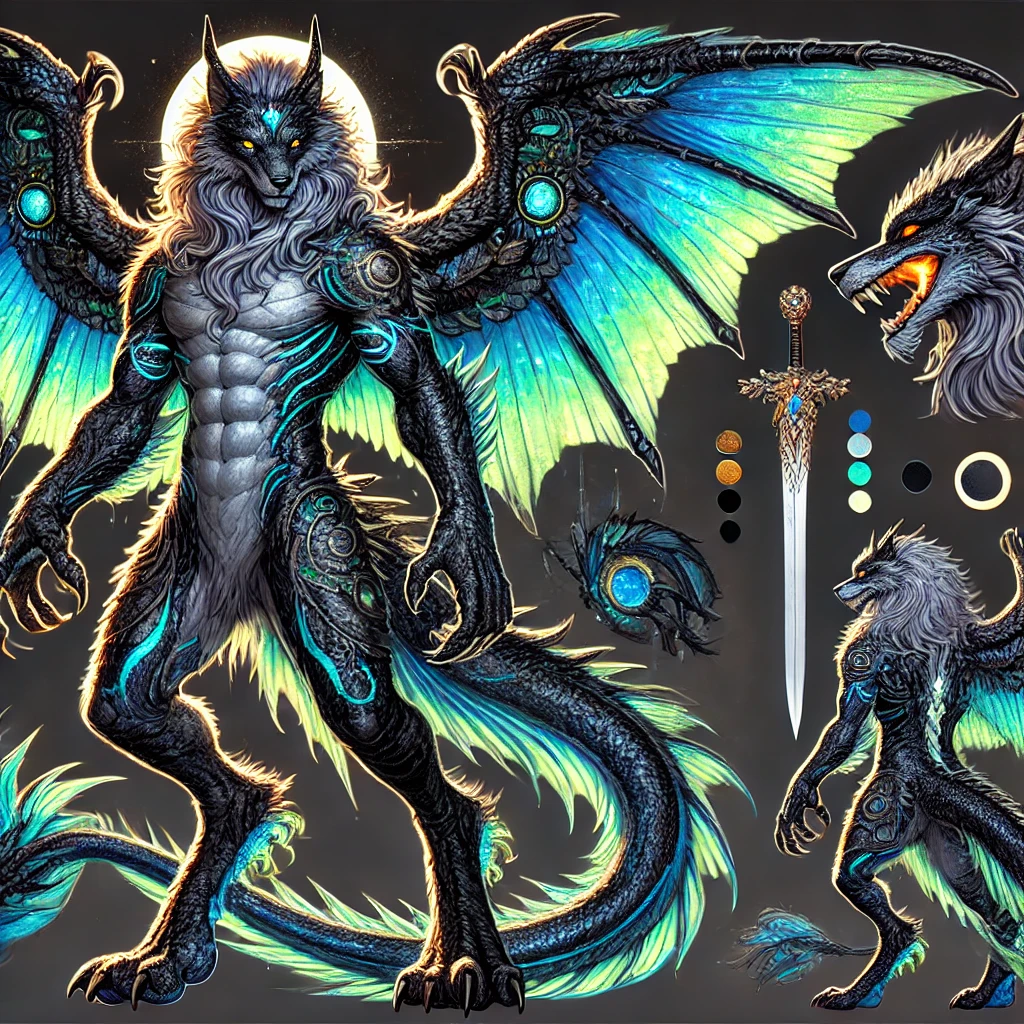
Sangrahin
A sorberanth carrying five lives in one body, who would rather spend an evening asking you questions.
- Gender
- Fluid
- Pronouns
- he/she/they
- Species
Name
Saṃgraha is Sanskrit for a gathering-together — a collection, an assemblage, things brought into one place. The same word also means comprehension: grasping something, taking it in with the mind. Sanskrit treats collecting and understanding as one act, and does not distinguish between them.
-in is a Sanskrit agentive suffix: one who does this, one who has this.
One who gathers and one who grasps are the same reading. They have taken five lives permanently into one body, and what they do with every hour they are not doing that is try to understand something. The word was already there.
Temperament
Very little rattles Sangrahin. They are entirely capable of excitement and it surfaces as interest — a thing catches, the attention sharpens, and the energy stays exactly where it was. The calm is their own. Of everything they carry that came from somewhere else, this is not part of it.
Underneath the calm is an appetite that does not close. They want to know things, they want to know why things are the way they are, and they will follow a question a long way past the point where it stopped being useful to anyone.
This is why they prefer three people to eight. Small groups and single conversations are where a subject can actually be opened, and a crowd never gets past the surface of anything. They ask a great deal, they love philosophy, and a question put to them comes back answered in full rather than acknowledged.
What earns their attention is someone who genuinely cares what is being said and genuinely wants to know things. Someone who does neither loses them quickly and without any scene being made about it.
What loses them entirely is carelessness about other people. Anyone indifferent to the effect they are having, or to what the people around them feel, gets coldness first — and coldness is where it stops only if it stops there. They care about how people feel with an intensity that sits oddly against the rest of their temperament, and cruelty on that front is the one thing capable of genuinely enraging them.
They have used the absorption more than once, and every time under one of two circumstances: it was offered to them as a gift, or the creature had to be stopped. They would do it again in either case and they carry no guilt about any of it. They would never use it outside those circumstances, and they hold anyone who would abuse it in open contempt.
They took memories from some of the creatures, and only ever the memories they had been told they could take. What arrived with the bodies arrived complete — the instincts belonging to five other lives are as much theirs now as they ever were their originals’, and none of them runs ahead of them or acts on its own.
Their gender moves, and it moves unpredictably. Some stretches are he, some are she, some are they, and there is no schedule to it and no cause to look for. The body stays exactly as it is throughout. There is nothing in it waiting to be resolved and nothing in it that has yet to settle; this is simply how they run.
Physical description
Sangrahin is interested in you, and it is the first thing that shows. There is a great deal of them and none of it is pushed at anyone; the power sitting underneath is plain enough without ever being demonstrated. They are strange-looking and entirely at ease with it. They are also difficult to take in all at once, so there is always something further to find, and they are easy to talk to for a good deal longer than anyone plans on.
They run around twenty feet, serpentine end to end, thick and heavily muscled through the length. The body is deep through the front third and tapers a long way back from there. Everything that has been added to them sits on that frame, and the serpent is obvious at a glance regardless of how much else there is to look at.
None of the additions have joins. The scaling flows into hide, which flows into skin, which flows into plating, and the transitions are gradual everywhere — a sorberanth body is built to take things in and it does the work well. What the additions do have is contrast. The parts came from five different creatures and they look it, and the assembled result is strange and a little disconcerting on first sight, and then simply what they are.
Their own fine, close-set scales cover the base of them and most of the tail, and they are iridescent, shifting with the angle. Everything else is borrowed. Heavier draconic plating lies over the vital areas where the finer scaling needs the reinforcement. Wyvern hide and tiefling skin sit wherever the body wanted flexibility more than armour. Where each of those begins is a gradient rather than an edge.
The base colour is deep green, running from forest through to nearly black, with dark red and oxblood patterning beneath it and banding down the length. The borrowed limbs keep their own colours and stand plainly against all of that: pale skin on one pair of arms, deep purple on another. The blending in them is structural. The palette was left alone.
Six arms run down the torso in three pairs, stacked one above the next, and each pair sits wider apart than the one above it. The fae pair is highest and closest together, pale-skinned, ending in six-fingered hands that look delicate and are not. The harpy pair is in the middle, ending in humanoid hands with claws on the fingers. The tiefling pair is lowest and widest, deep purple. No pair leads. They use whichever suits the work or whichever they feel like reaching with, and the fae hands do the fine work while the tiefling hands take anything dangerous, since tiefling skin is thicker and does not burn.
Six legs sit further back along the body. Four came from the dragon and end in paws with claws. Two came from the tiefling, and those are the ones they stand upright on.
Bark-like markings are worked into the scales and skin in places, blended in rather than laid over.
Three arrangements are available to them and they move between all three easily, because this is exactly the sort of thing a sorberanth body is built to do. Standing upright on the tiefling legs, the four dragon legs work as additional arms — fewer joints and less dexterity than the hands above them, and perfectly capable. Down on all fours on the dragon legs, the tiefling legs either fold along the frame or cross against the body. Flat and fully serpentine, every limb spreads out to the sides and the length does the moving. Which of the three they are in comes down to comfort and mood and often nothing at all, and terrain settles it when terrain has an opinion.
Two pairs of wings ride at their sides throughout. One pair is the harpy’s, feathered. The other came from the wyvern and runs larger than a wyvern’s, because the dragon’s influence reached them too. They fold along the body as any wings do.
Their head reads as draconic first. The snout is heavy and carries the shape, and the jaw and teeth beneath it are heavier than a sorberanth’s own. Tiefling horns sweep back in an antelope’s curve, passing around the antennae and straightening near the ends into points, and they have been used. The antennae are the fae’s, set on top of the skull, and they move — they sense with them and they show what they are feeling with them. Auburn hair runs from the head and well down past the neck, soft, flowing smoothly around both the horns and the antennae.
Four eyes sit in the face in two pairs. The forward pair is dark brown and does the work of depth. The pair angled out to the sides is a vivid blue, the same size as the forward pair, and both are attended at once. The harpy gaze travels through all four of them.
The face comes apart into ten sections. Closed, no seam shows anywhere. How fast it opens is theirs to choose, and they open it in front of people without any shame attached, taking care over it where care is warranted.
The tail carries the stinger and the retractable fin-like blades, which lie flat most of the time and are unmistakable when they rise. A second tail grows from the base of the first — the tiefling’s, fully prehensile, used for holding things and for holding people.
Beneath all of it lies the harpy armour layer, folded under the skin across the whole of them, the limbs and the length included. It rises and recedes as smoothly on them as on a harpy born to it. Raised, it is plainly visible across every stretch that is not already scaled, and over the scaled stretches it layers cleanly on top, closing the fit tighter and making them considerably harder to get through.
They carry four elements: fire from the dragon, storm from the wyvern, earth from the fae and water from the harpy. The channelling consolidated rather than staying with its sources, so any element comes out of any limb. The tail, the wings and the hands are the precise instruments and the claws and the breath are the strong ones. The only real constraint is the elements themselves — fire and water out of the same hand produce steam or scalding water depending on the mix, while water and storm simply run together, having nothing to argue about.
They also carry hellfire and dark magic from the tiefling, and a will affinity from the fae. None of it shows at rest. In use, the hellfire is visible as itself, and the dark magic appears as whatever it is being shaped into, usually a black or dark violet energy. The will affinity is never visible at all.
The tiefling’s fire immunity came across partially. Where there is tiefling skin it is complete, and across the rest of them it is a strong resistance.
Three venoms are available to them, and keeping them apart takes no effort and never did. Their own two ride in the stinger and along the blades — one that paralyses or kills, one that is pleasant and does no harm — and which arrives is chosen at the moment of delivery. The wyvern venom is the third, storm-natured, delivered by bite and by tail alike, carrying the convulsive expression and the one that runs in tingling waves.
The harpy mass came with the harpy build, and on a body this size it disappears into the total. They are heavier and stronger for it than they look, and it is apparent when they exert and easy to miss otherwise.
What they are feeling shows in the eyes and in the coils — where the coils have gone, how tightly they are held, what they have arranged themselves around. When they become genuinely interested the head comes down to eye level, and it is the clearest thing they do. Curiosity catching hold reads as intrigue rather than excitement, and it is a change of attention rather than a change of energy. Anger looks like none of the rest: the blades come up, the harpy armour comes up with them, and it arrives in the posture and the eyes at once.
They move flowing and unhurried and can be very fast when there is a reason. A considerable amount of predatory instinct came in with everything else, so they can be extremely quiet when they want to be, and they mostly do not bother. They coil into whatever furniture or landscape is available and stay in it. They fly as well as they do anything else, which is unsurprising given three separate creatures’ flight instincts arrived along with two sets of wings.
The atmosphere around Sangrahin is one where conversations end up deeper than they were heading. People tell them things. An hour disappears without anyone tracking it. There is an obvious floor of power under the calm and it never needs demonstrating. It is a safe place to be uncertain, because a half-formed thought interests them more than a finished one does. And anyone careless with the people around them finds the warmth withdraw, quietly, completely, and without a word about it.
They smell of warm earth after rain and of old paper and dust, the particular smell of a room with a great many books in it, with something faintly sulphurous well underneath from the hellfire.
Sangrahin is something enormous coiled in a warm room, listening. They are the conversation that outlasted the fire it was held in front of, an old tree with several other things growing on it and every one of them thriving, and a map assembled out of many people’s journeys. Five lives ended inside them and became one, and what that one wants is to understand things, and to be told about them by somebody who cares that they are true.