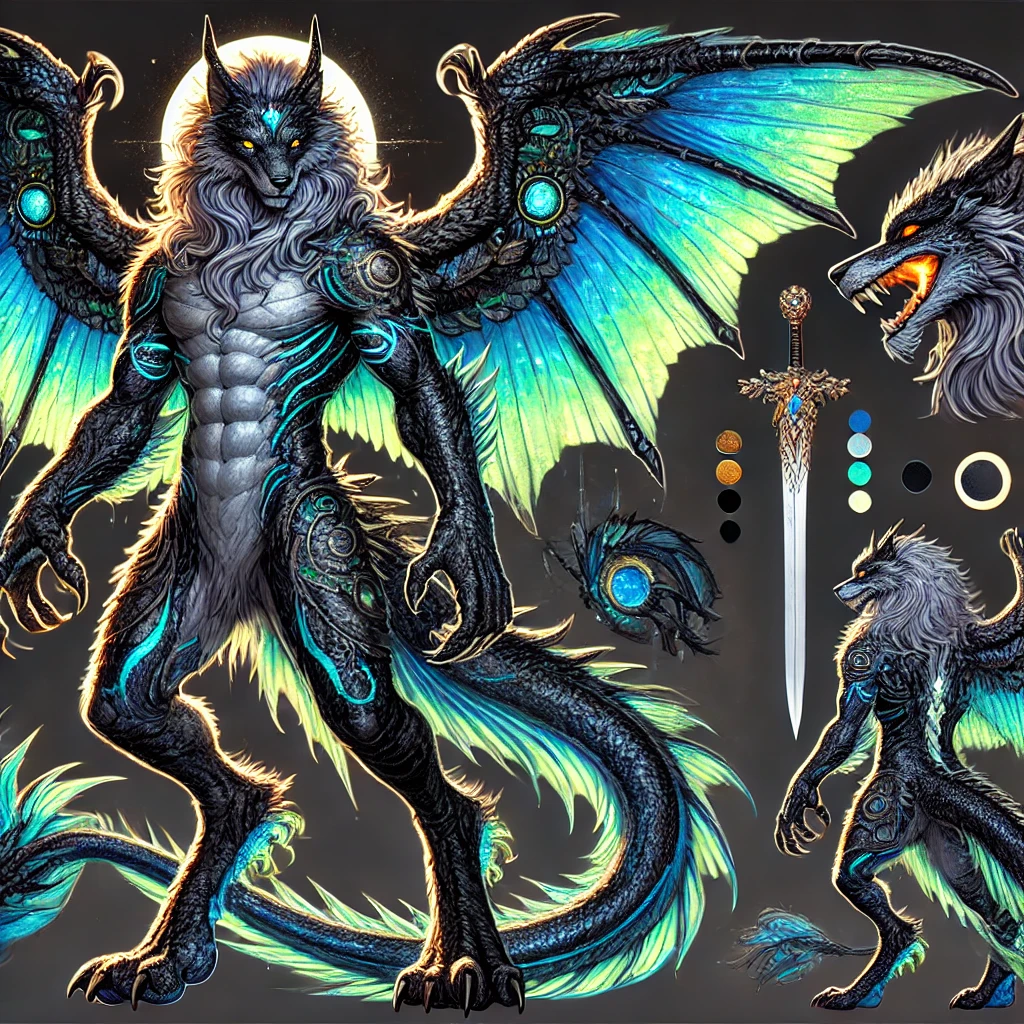
Species Field Guide
What follows is a guide to the species we are, written from the inside. Where a species shares a name with something from folklore, mythology or biology, that material is background — it gave us a name and sometimes a shape, and it is recorded further down each entry for context. It is not the authority on what we are. We follow feeling rather than fact.
Four things hold across every entry in this guide.
Temperament belongs to the individual, never to the species. A species may share instincts, senses or baseline biology — the way Feliry share heightened senses, or Luperin share pack instinct — but shared instinct is not shared personality. Where an entry describes how someone carries themselves, that description belongs to that person alone and is recorded on their own page, not here.
Appearance is not obliged to match a baseline. Members may present with exotic colouring, unusual textures, or builds well outside what their species is expected to look like. Where an entry gives a range, the range is the description; where it gives a single form, that is a shared structural fact and the entry says so plainly.
Magic is individual unless a species fixes it. Many of us are tied to magic in some way, and that tie is our own. A few species do fix something — a dragon’s element, the hellfire every tiefling carries — and where that is true, the entry says exactly what is fixed and leaves everything else open.
Every member is fully sentient and self-determined. This holds regardless of whether a species is considered sentient in biology, folklore or fiction. Each of us decides who we are and how we act. It is not granted unevenly, and it is not an exception made for anyone.
A note on the animal entries
Several entries here share a name with an ordinary Earth animal — wolf, fox, coyote, lion, tiger, snow leopard, seal, otter, dolphin, crocodile. Those entries describe sentient creatures, not ordinary animals.
Strictly the accurate words would be wolfakin, foxkin, liokin and so on, and we do not use them because they make everything they touch harder to read for no real gain. Read the animal entries as describing kin throughout.
They are built on the real animal, and the biology in those entries is accurate as far as it goes. What it does not cover is that these are thinking beings who communicate in far more complex ways than the ordinary animal does, who live a good deal longer for being tied to magic, and whose bodies vary in size accordingly. They live on Earth rather than in the Veil, because they can pass as what they resemble without difficulty.
Ordinary animals still exist. That some wolves are wolfakin does not mean every wolf is one.
Two things hold across all ten of those entries and are not repeated on each. Body size varies considerably from one individual to the next, and how much depends on their magic among other factors. And the natural species and subspecies of the animal function as breeds, carrying the differences in size, coat and habitat you would expect between them — where an entry has a breed that is not simply a subspecies, it says so.
-
Gumiho
Fox shapeshifters who wear what they have eaten — and keep it in proportion to how much.
-
Harpy
Wings, talons and a beaked mouth on a humanoid frame — and a gaze that keeps hold of you after it looks away.
-
Hellhound
Twin-tailed demons of the deeper Veil, with hellfire running through the coat.
-
Hypnosphex
Upright, four-legged and winged, with a wasp's sting behind them — and a buzz whose hold lingers long after it falls silent.
-
Jorōgumo
Spider shapeshifters whose silk almost nothing can cut — hellfire included.
-
Kitsune
Fox shapeshifters who feed on souls and count their power in tails.
-
Kraken
Branching horns, clawed tentacles, a voice that catches — and an ink that remakes whatever it reaches.
-
Lamia
Serpent below, and a gaze that almost nothing shakes off.
-
Leviathan
Serpent and swimmer, web-pawed and equally easy on land — carrying water and kinetic magic both.
-
Lion
Sun-tied and pride-led — the cat that hunts cooperatively.