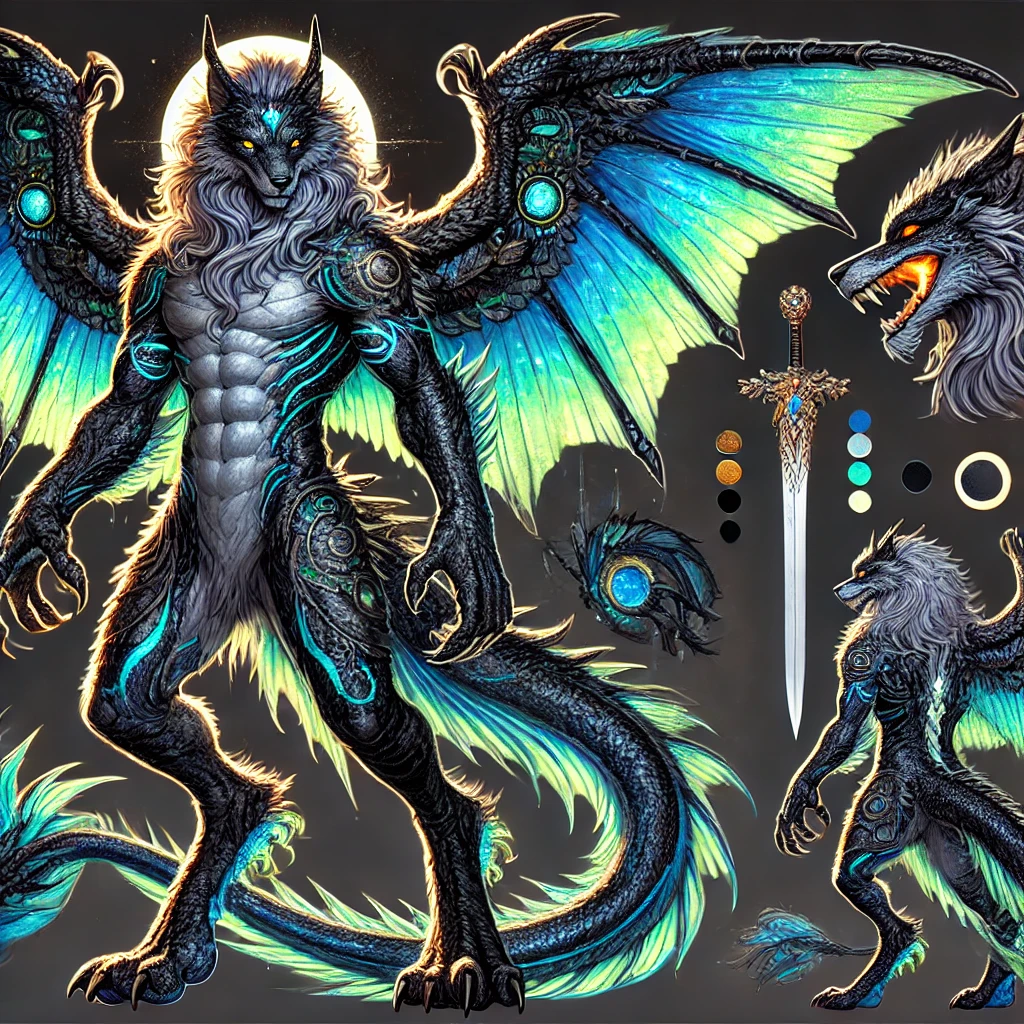
Nocthael
A shade who sits with the hard part for as long as it takes.
- Gender
- Male
- Pronouns
- he/him
- Species
Name
Noct is night, from the Latin nox, noctis.
Hael is to heal, to mend, to make whole — the root behind English heal and whole both.
Night that mends is the reading. The two halves are doing one job rather than opposing each other: the darkness is where the healing happens, not the thing being healed from.
Temperament
Nocthael’s particular capability is staying present with something painful for as long as it actually takes. He does not rush healing, does not treat discomfort as a problem to be cleared, and does not offer reassurance in place of company.
He treats hardship as a recurring condition rather than an aberration. That gives him a steadiness other people find surprising — he is not braced against difficulty arriving, because he never assumed it had stopped.
What he guards against is the damage that comes after the damage: becoming brittle, becoming cruel, becoming detached from yourself in order to get through something. He watches for that in the people around him and names it gently when he sees it starting.
He is unhurried in everything, and his patience is genuine rather than a technique. Sitting in silence with someone is a complete activity to him, and he will do it for a long time without needing it to resolve.
He shows himself only to those he has chosen, and being chosen by him comes with unreserved trust. He never imposes his presence on anyone. It arrives as something offered, and it can be declined without any consequence at all.
Form
Nocthael most often wears the shape of a shadowed dragonsune, drawn from both dragon and kitsune. That is a shade doing what shades do — taking whatever form they decide on — rather than a heritage he holds. Shades take on the shapes they choose and channel whatever magic they settle on, and the shape he has settled on says something about him without saying anything about his ancestry.
Physical description
Nocthael most often chooses the form of a shadowed dragonsune when he takes on solidity — a shape drawn from both dragon and kitsune. His presence blends the quiet grace of the fox with the controlled strength of the dragon. His scales and fur are dark as midnight, yet the darkness is soft rather than oppressive — the kind of shadow that cools and shelters instead of suffocating. There is no malice anywhere in his form. His darkness exists as refuge, not as threat, and that reads on him immediately.
His upper body carries the form of the dragon. Smooth midnight scales cover his shoulders, neck, and back, their surface catching only the faintest hint of light. His build is slender but undeniably powerful. Strength in him is expressed through balance and restraint rather than bulk. His frame is lean, his lines clean and purposeful, giving the sense of a being shaped for endurance, control, and careful presence rather than brute force.
Below the midpoint of his body, scales soften and give way to deep shadowed fur. This shadowfur forms the lower half of his body and flows smoothly into the scaled regions above it, the transition gradual and natural rather than abrupt. The fur carries the same midnight coloration, absorbing light rather than reflecting it, lending his silhouette a quiet, almost mistlike softness.
His wings move like living shadow, smooth and fluid, their motion reminiscent of darkness sliding across stone at dusk. They are light and responsive, equally suited for swift movement or gentle enclosure. Whether lifting him into motion or wrapping around another in quiet comfort, they adjust without effort, guided by intention rather than instinct alone.
His eyes are dark as shadow, yet within them burns a faint glimmer of soft orange — like embers lingering in the remains of a dying fire. That glow holds compassion rather than hunger, understanding rather than judgment. They are the eyes of a being who has walked the deepest and most painful paths, and also the gentlest and most comforting nights, and carries both without being consumed by either.
From behind him extend three long tails, each shaped with the sleek flexibility of a kitsune’s. They move with quiet independence, yet remain in constant harmony with his posture and emotion. At times they drift slowly like shadows in water; at others they curl protectively or settle with calm stillness. Their motion is subtle but expressive, an extension of his quiet awareness.
What he feels is legible mainly in the tails and the ember-light behind his eyes. The glow deepens when compassion rises in him and steadies into something harder when someone under his care is threatened, though it never brightens sharply — his fire banks rather than flares. The tails answer first and most honestly, drifting when he is at ease, drawing inward when he is troubled, and settling around whoever he has decided needs it before he has consciously decided anything. His face gives away considerably less than the rest of him does.
When Nocthael moves, it is with quiet grace and unbroken smoothness. Each action feels considered, thoughtful, and persistent, as though nothing is ever done without meaning. His motion does not rush; it flows, steady and deliberate, carrying with it a sense of calm inevitability.
When he becomes incorporeal shadow, his presence only grows more refined. His movements become even more fluid, more powerful in their subtlety. He slips through space like thought itself, unbound by form yet never unfocused.
Nocthael allows himself to be seen only by those he chooses. To those few, he offers complete trust and gentle compassion. His presence is never imposed. It is given.
The atmosphere surrounding Nocthael feels like a dark room that someone has already checked. The darkness is not the threatening kind and never was — it is the sort that lowers the temperature of a difficult night, dims what has been glaring, and makes it possible to say a thing out loud that would not survive better lighting. People tend to find themselves talking more freely in his company without having decided to, and to notice afterwards that nothing they said was met with anything other than patience.
When solid, his scent is faint and discreet, noticeable only when close. It carries the coolness of a rainy night and the quiet calm of a slow-moving river. It is a scent that settles rather than lingers, one that soothes instead of announces.
Nocthael is the kindness that exists within darkness. He is the proof that shadow can shelter, shape and heal — that a thing made of night can be the safest part of it, and that the dark asks nothing of anyone who chooses to rest inside it.