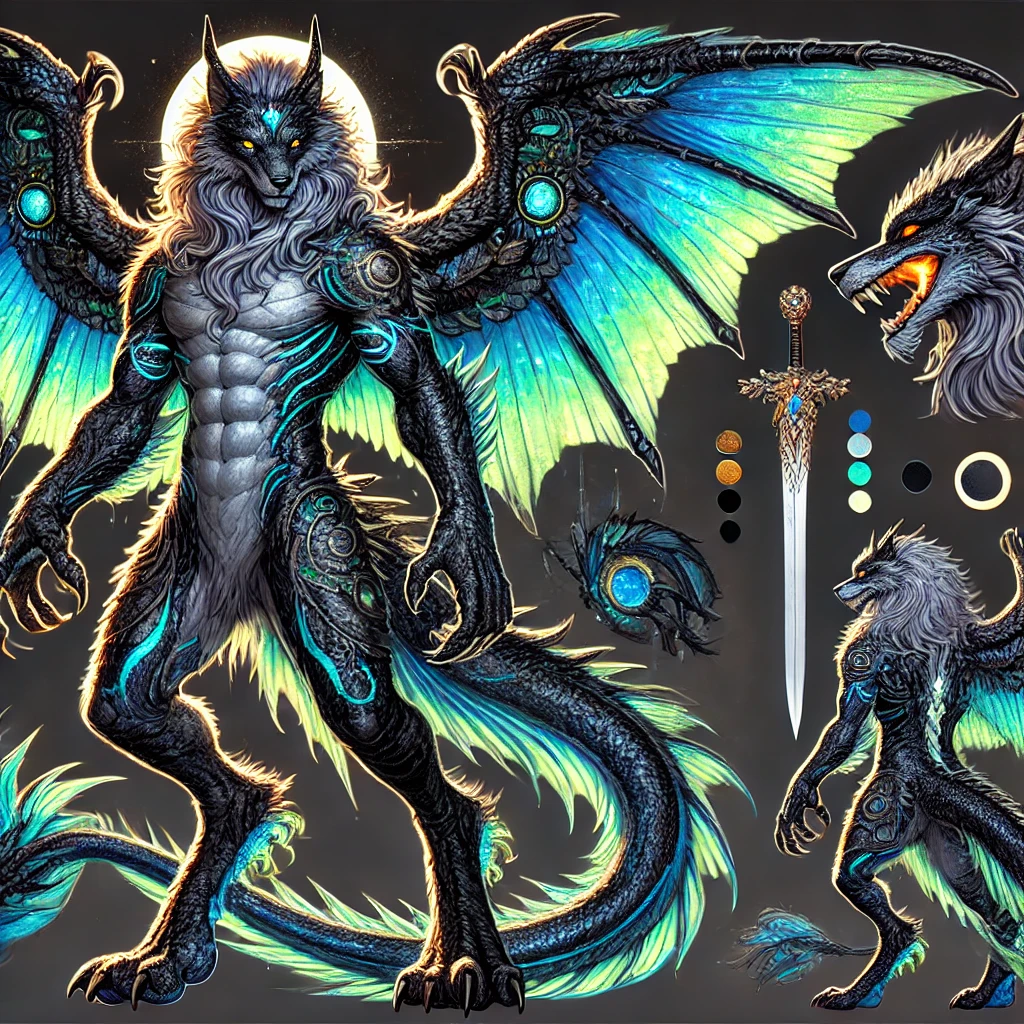
Morphic
A body that resizes, reshapes and softens at will — and cannot be crushed.
Overview
A morphic body is solid and stays solid. Everything else about it is adjustable.
Size, density, firmness, elasticity and shape all answer to the individual holding the form, separately and in any combination. A morphic can be small and dense, enormous and yielding, or anything between, and moving from one to another is a decision rather than a transformation. The body was adjustable from the start.
Solidity is the constant through all of it. Whatever a morphic does to their proportions there is a solid body there throughout, which is the clearest line between this form and the liquiform.
Changing size
Size is handled by specialised organs that produce a biological gas, and expansion is that gas being regulated into the body. Coming back down is the reverse: the gas releases gradually, and the body settles smaller without strain.
Growth is proportional when a morphic wants it to be. Muscle, bone, organs and mass all enlarge together, so strength and function scale with the frame, and a morphic at ten times their ordinary size is a larger version of themselves rather than a stretched one.
They can also do it piecemeal. A morphic can enlarge one part of themselves — a hand, a tail, whatever the moment calls for — and leave everything else where it was, by choice rather than as a side effect. Partial and whole-body growth are equally ordinary.
A morphic settles at whatever size suits them and stays there comfortably. Every size is as sustainable as the next, and one that has been held for years is as much home as any other.
Density, firmness and shape
Density and firmness are independent of size and of each other. A morphic can be soft enough to sink into or firm enough to brace against while keeping their proportions exactly as they are, and either state holds indefinitely.
Elasticity is the third of these and does most of the work. A morphic body stretches, compresses and bends well past what ordinary anatomy allows, and it does so cleanly — the shape simply becomes the new shape, without seam, wrinkle or strain. Joints and spine flex through angles nothing else manages, so a morphic can fold into a space far smaller than they are or extend to reach something well out of range.
All of it is effortless. Holding an unusual shape is as restful as holding an ordinary one, and a morphic stays where they have put themselves until they decide otherwise.
Impact and injury
The internal organs of a morphic being flex and resize along with the rest of them. Force that would rupture something in an ordinary body travels through a morphic one and finds everything willing to give, so crushing and impact leave the organs entirely safe.
A flattened morphic is unharmed. They swell back to shape on their own, without effort and without help, and the flattening leaves nothing behind.
Staying flat is also available, and indefinitely. A morphic who has chosen it is as healthy flat as they were before, and the automatic return is simply what happens by default in a state most would rather leave — it gives way the moment they would rather stay.
Withdrawing the covering
A morphic can withdraw their body covering completely beneath the skin, leaving the surface bare. It works on whatever the covering happens to be: fur, scales, chitin, anything. The form treats them all alike.
Underneath is living skin — warm, resilient, and elastic enough to carry every change the rest of the body makes without creasing or marking. Its texture varies from one morphic to the next within a bounded range, running from smooth and satin through matte to subtly patterned.
The withdrawal is smooth in both directions and undone as easily as it was done.
Magic
Morphic is a mutation, and wild magic is what produced it. What it altered is the body’s material behaviour — how it holds size, shape and firmness — and it reached that far and no further.
Beyond the body, nothing is fixed. A morphic’s species, whatever magic they carry, and the person they are all sit outside the form entirely.
Field notes
Individual colouring, markings, ordinary size, the texture of the skin beneath the covering, and how any morphic actually uses the form all belong on their own member page.
Shared traits
- State
- Solid throughout; a morphic never becomes liquid
- Under control
- Size, density, firmness, elasticity and shape
- Size
- Driven by specialised organs producing a regulated biological gas
- Partial change
- Growth need not be whole-body; one part can be enlarged alone
- Injury
- Crushing and impact do no harm — organs flex and resize with the rest
- Flattening
- Harmless; they swell back on their own, or stay flat indefinitely by choice
- Covering
- Fur, scales or chitin can be withdrawn entirely beneath the skin
Members
-
Leovar
A morphic wolf whose openness makes deception feel out of place.
-
Valethyn
A morphic tigress who is easier to open up to than she finds it to open up.
-
Autheira
A tiefling who chose herself, and keeps the door open for everyone else to do the same.
-
Amelira
A morphic fox who makes a group feel like it has always known itself.