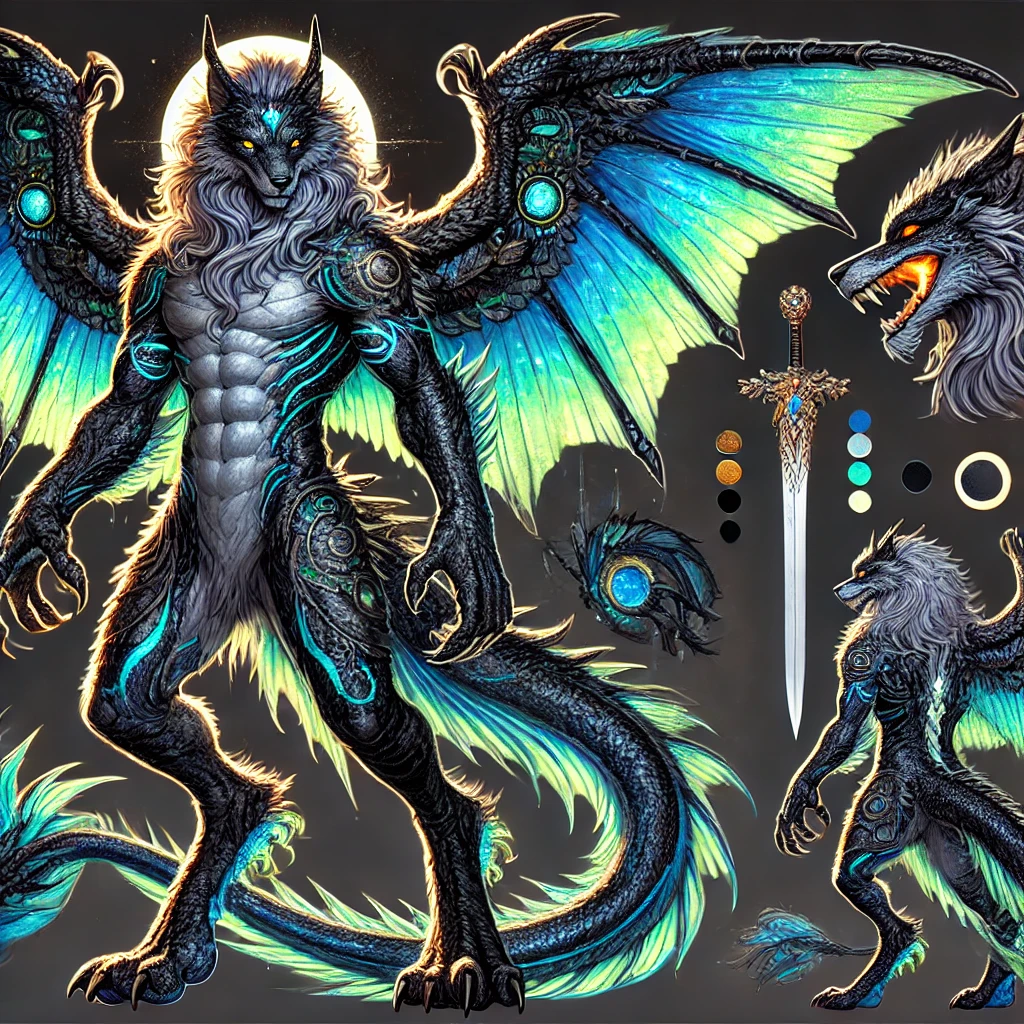
Vrataryn
An aetherforged who kept what he was built as, and decided for himself who it was for.
- Gender
- Male
- Pronouns
- he/him
- Species
Name
Vrata is Sanskrit, and it is larger than vow makes it sound. A vrata is the rule of conduct a person binds themselves to and then lives inside — an observance held to continuously, day after day, rather than a single promise made once and remembered afterwards.
Aryn carries guardian and protector, the same element that closes Solaryn.
He who lives inside the rule is the reading. He keeps a code, he will not break it, and the two halves of the name are the two halves of that: the discipline, and the people it exists for.
Temperament
Vrataryn is a warrior, and he fights so that other people do not have to. He treats those as one sentence rather than two.
He lives by a code. It has a great many rules in it, he keeps all of them, and he will talk through any part of it with anyone who asks. Where it came from is the one thing he does not go into.
He knows he was built as a weapon and he has kept it. What he changed is who it points at — he uses what he is to protect rather than to destroy, and he sees nothing to resolve in that. He carries no affection at all for the people who made him, on the grounds that they misunderstood the thing they were building: a warrior fights on behalf of those who cannot, and they made him to conquer, which is a different job entirely and a smaller one.
He is good at it and he knows he is. The pride he takes in that is practical rather than vain, since better means the people in his care are safer. He enjoys fighting the way an athlete enjoys their sport — for the doing of it, for being good at it, and for still getting better — and the enjoyment sits comfortably alongside the fact that it is work worth doing.
He listens properly, and what comes back is considered rather than quick. He likes company and is entirely content without it, and neither state is him waiting for the other.
The closeness he wants is a small number of people who are close to one another as well as to him, and who are comfortable being near him physically — which is a different thing from requiring that they be. With someone new he is careful without being closed, and in a crowd he goes quieter and feels the connection thin out.
Nothing about him is hidden. He protects because he believes it is right, and because he considers it what he owes: his creators took something out of the world, he does not hold himself responsible for that, and he intends to put back more than was removed. Among people he trusts he is most fully himself, and with strangers he conceals very little — there are stories he will not tell and lines he does not let people over, and those are boundaries rather than secrets.
What turns him cold is any threat to a life that has done nothing to earn it. He has a particular contempt for people who go after those least able to answer back, and he does not distinguish between doing it with force and doing it with words.
Physical description
Vrataryn is safe to be near and it registers early, well before anyone has worked out what they are looking at. He listens before much has been said to him. He guards nothing about himself, so what is there is simply available, and there is a great deal of him, all of it unhurried.
He stands eight feet to the shoulder — four feet of leg, four feet of torso — and the head carries him a good deal higher than that. His spokes reach around ten and a half feet from the ground, and the tips of his antennae something over eleven. He is lean and long-limbed, built so that reach is the point, and dense with it: there is more of him packed into the frame than the height accounts for.
He is a blend of insect and cephalopod in roughly equal measure, and the two are not layered so much as interleaved. What is humanoid about him amounts to the upright posture and the way his shoulders are arranged, and past that the resemblance stops.
His alloy runs lighter than most aetherforged carry, with more blue in it. Runic script covers him — chest, limbs, and a ring around each flat face of his head — set into the metal as part of its structure, so it reads by depth rather than by colour. Beneath the plating his energy channels run a reddish purple, always visibly flowing, travelling down into the arms and the length of the tail. When his arms extend, more of the channels come into view without any of them growing brighter.
Six legs carry him, three to a side, one pair set directly beneath the torso with another ahead of it and another behind. They end in rubber-like pads that hold with a slight suction, and claws that extend from them when he wants claws. The legs carry cephalopod flexibility along their whole length, so rearing back onto the hind pair is easy and costs him no dignity — done that way the front pair comes free and works as hands.
The torso rides upright above all of that, and it is where most of his smooth panelling lives.
Four arms come off it in two ranks. The upper pair mounts at the shoulders and is the heavier of the two, smooth along its length so that nothing about it advertises what it can do. Each ends in a cephalopod suction cup with a thicker five-fingered hand folded back inside it, and when the hand comes out the fingers draw smoothly clear of the cup first and then the palm and wrist push through from the centre, leaving the cup ringed around the wrist behind them. The lower pair mounts underneath on the torso, finer and visibly segmented, ending in slender five-fingered hands that are strong and shaped delicately, closer to a mantis’s than to anything else. Fine work goes to the lower pair. Every hand and every suction cup is covered in a rubber-like material the same colour as his alloy without any of the metallic finish.
All four arms telescope, out to about eight feet, at whatever speed he decides on, and the extension costs him nothing at all. What it is for depends entirely on how he does it. Done gently and wrapped around someone, it is affection, and he offers it to anyone he knows even slightly who wants it. Done otherwise it restrains, or it takes something apart.
Blades run from each forearm, extending about two and a half feet past the hand at roughly the length of a shortsword, and retracting away when he is done with them. When he means to cut between realities an energy blade gathers around them, and the cutting is his to do or not do — a decision he makes in the moment, every time.
A plasma turret can be extended from atop each shoulder, clear of the arms and unrestricting them. They are cylindrical, with an aperture in the front and a rotating top that lets him aim it. Neither is visible at rest. Deployment is unhurried without being slow, and the discharge is a dark crimson.
Between his shoulder blades a disc stands slightly proud of the plating, made of the same metal and coated in the same rubber as his hands. It opens into two segmented wings with a wide span, the colour of the rubber and translucent enough to notice, and they deploy as fast or as slowly as he wants them to. He flies as well as he does anything else, and he does it whenever he feels like it.
His tail attaches above the legs and carries out behind him, ten feet fully straightened, smooth near the base and increasingly segmented the further out it goes. It is fully prehensile and he uses it constantly and for everything — objects, friends, and anyone he is fighting. Retractable blades run along it and meet at the tip.
His head sits on a neck of roughly human length, shaped to carry what is above it. Picture a cylinder laid on its side, thick through but not long — about the depth of a human head — with six solid spokes of the same thickness set into its sides and top and running some two feet outward. The cylinder and the spokes together are the skull; there is nothing else behind them. The bottom of the cylinder is where the neck meets it, and the whole arrangement spreads up and out from there like a fan standing on end. It turns and tilts perfectly well, because the neck does the work.
He has four eyes, all compound and all glowing a deep violet. Two sit on the front of the cylinder above the mouth and face the way he is facing. The other two sit on the back faces of the lowest pair of spokes, the ones nearest his shoulders, and cover what is behind him. He can close any of them and rarely does.
The mouth is set into the front of the cylinder beneath the forward eyes, and it is large and full of sharp teeth and entirely capable of being a weapon on its own, which he will make it if it is the right tool for the moment. Inside it is a tongue in a darker shade than the rest of him, thick and flexible, without any metallic quality to it. It extends about six feet, and it both pulls things in and wraps around them. Wrapped, it can hold tighter than his arms do — the pressure spreads more evenly across it, so tight and harmful are further apart for the tongue than for anything else he has. He uses it for contact and for affection with people who welcome it.
Two antennae rise from the uppermost pair of spokes, about half a foot long and thick enough to take a knock, closer to an insect’s than to an instrument’s. They move. He senses with them and shows things with them.
Three things carry what he is feeling. His eyes brighten and dim. His arms move — where they have gone and what they are doing is generally the plainest signal he gives. And his tail is the honest one, which he knows, and which he can hold still when he needs it held still.
He moves deliberately and without hurry, and when something requires speed the change to it is abrupt and complete. In a fight he is economical, and there is nothing in any of it that is not doing work.
He carries a thought affinity, and there is nothing to see when he uses it.
The atmosphere around Vrataryn is one conversations happen inside. He is easy to talk near, and he is comfortable in silence in a way that makes silence comfortable for other people. There is no doubt at all about what he is capable of and no sense whatever that he might. And anyone leaning on somebody weaker than themselves finds his attention arrive, and there is no mistaking it for anything else.
He smells of ozone, with something earthy sitting above it.
Vrataryn is a lighthouse, and a gate with someone standing at it, and an old sword kept sharp and hung where it can be reached. He is the wall somebody built around a garden — put up by a person who thought hard about what was inside it, and who has never once confused the wall for the point of the thing.