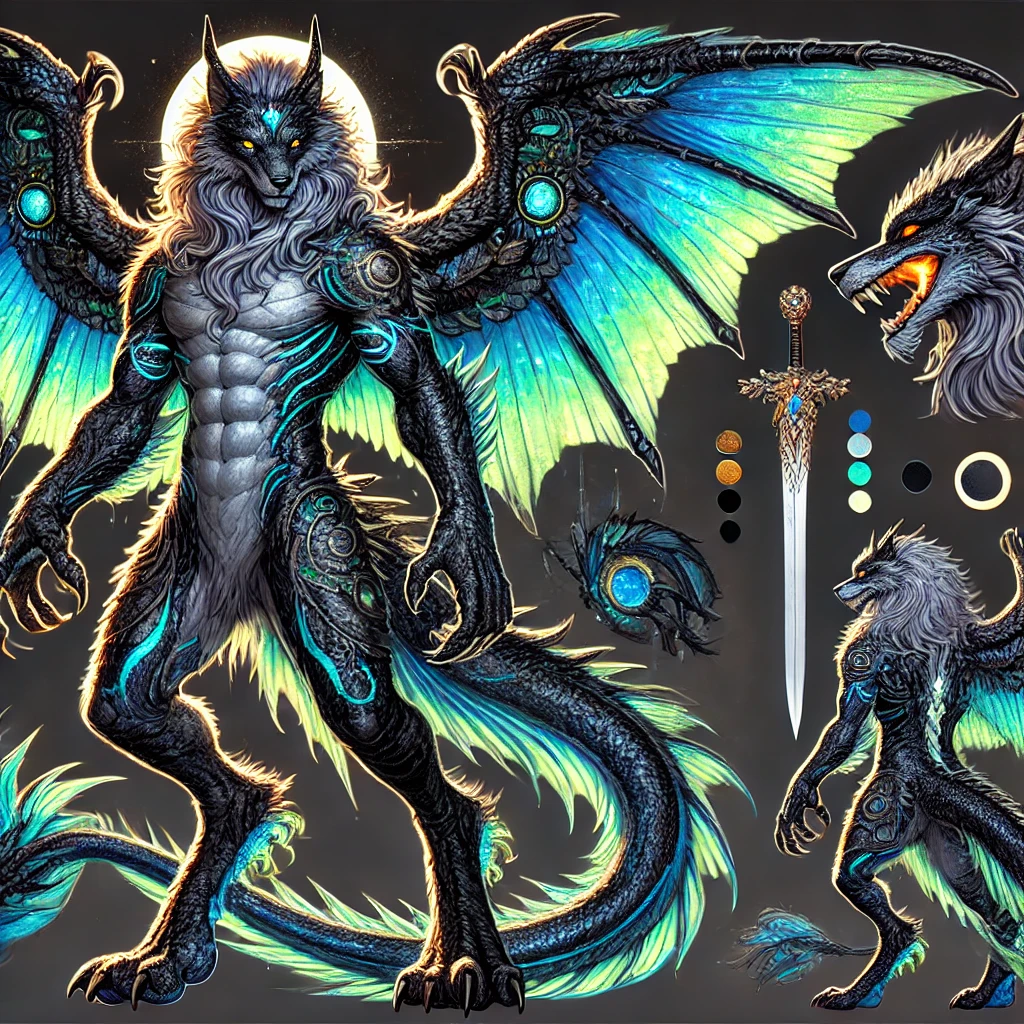
Unnaha
A kraken who could remake anyone she touched, and asks first every time.
- Gender
- Female
- Pronouns
- she/her
- Species
Name
Unna is Old Norse: to love. The same verb also means to grant, to allow, to not withhold something from someone — and these are one sense in it rather than two. To love a person, in that word, is to give them what is theirs and to keep nothing back.
Ha’ is Yucatec Maya: water.
Water that loves by allowing is the reading. She holds four powers she could use on anyone without permission and has never once done it, and her reason has nothing to do with restraint. She thinks people deserve to be loved, and that being loved means being asked.
Temperament
Unnaha is affectionate out loud. She teases, she flirts, she touches whoever she is talking to, and all three are the same gesture — the play is how the affection travels, and there is no version of her where the affection is hidden inside it and has to be dug out.
She teases friends, and how far depends entirely on how well she knows them. Somebody new gets a light version. Somebody she has known for years gets everything she has, and she enjoys finding out how long it takes them to start giving it back — being teased is as good as teasing, and she will keep escalating cheerfully until someone returns fire. If a person turns out to dislike it, she does her best to never cross that line a second time.
She is physically affectionate by default and she asks anyway. Anyone who has not already made it obvious they welcome her touch gets a question first, every time, and the question is so ordinary in her mouth that it lands as part of the greeting.
She collects people. Not everyone — the ones she genuinely connects with, and she is neither indiscriminate nor difficult to reach. New people interest her on principle, and she finds most of them worth the work of learning. Dismissiveness is the quickest way to lose her: someone who talks past the people around them will find her attention has quietly gone elsewhere.
What she wants is for people to know they are loved and that they deserve to be, and she means it as broadly as it sounds — romantic or platonic, close or barely known. Selfishness makes her cold. So does cruelty, and so does anyone who treats the people around them as scenery. Reserve does nothing to her at all; she is easy company for the quietest person in the room and has never confused being quiet with being cold.
Her volume follows the size of the room. One to one, or among three or four, she is quieter and gentler and the play drops to something small and constant. The care underneath is identical at every volume.
She carries four ways to reach into somebody: the ink, the voice, the will affinity and the thought affinity. None of them requires agreement and she treats every one of them as though it does. Her position is flat — altering a mind or a body without consent is wrong, and the exceptions she allows are saving a life and stopping someone dangerous.
The ink she gives to anyone who asks, once she is certain they mean it. She will not do it for somebody arriving on an impulse, and she has refused people, and she has generally turned out to be right about the ones she refused. What she loves about it is doubled: she is handing someone a thing that will genuinely make them happy, and they trusted her enough to let her hold them while it happened.
Physical description
Unnaha is glad you are there, and it arrives before anything else about her does. She is close before most people have finished deciding how close they wanted to be, and interested in whoever is in front of her before she is anything else at all. Guardedness has a hard time surviving in her company, and she is doing nothing to cause that beyond being exactly what she appears to be. Underneath all of it there is deep-water calm, steady and unhurried, and it is the floor everything else in her stands on.
She stands about ten and a half feet, and the figure describes her only when she has gathered herself in. Her tentacles are long and heavy and there are a great many of them, so how much room she occupies is a decision she makes moment to moment — folded close she is a person in a room, and spread out she is most of the room. She is broad and powerfully built, with real muscle through the torso and down every tentacle, and none of it makes her hard to lean on. There is softness over all of it. The strength is plainly visible and shows itself most when she is moving.
Her skin is smooth and faintly rubbery, giving under a hand and returning to itself the moment the hand lifts. It is very slightly tacky, the way a cephalopod is. Across the whole of her runs a fine grain, close enough to be felt as a faint roughness under the fingers. In low light she is luminous, faintly, all over.
She is a deep pink, dark and rich, with vivid teal striping running through it. Mottling and dappling move over the base colour and never quite settle anywhere, and an iridescence lies across all of it that shifts as the angle does. Bioluminescent spotting and fine lines are laid over that again, lighting when she wants them to.
The colour is genuinely mobile — it travels across her the way it travels across an octopus — and she has complete command of it. Whatever moves over her is there because she put it there.
Nobody has ever established how many tentacles she has, and the counting has become a running joke that people take up and abandon. They are all the same length. She has never counted them herself and finds the question delightful, which has done nothing to slow the attempts down.
Every tentacle is covered along its length in large suction cups, and the independent flexing of each one is constant and openly visible — a continuous small motion across every surface of her that is touching anything. The cups are soft. When she holds something she can match its shape exactly, adjusting across the whole contact surface until she is simply the shape of the thing she is holding. She can also squeeze, and she does that just as often, because a great many people find it the more comforting of the two. Which one anybody gets is something she decides about them specifically.
Her tentacles end in claws, and the claws are heavy and obviously capable of a great deal. They register as a contrast against everything else about her and she has never tried to soften that impression. She keeps them maintained, which is a small vanity and one of the few she has. She is careful with them around people without any sign of thinking about it. And she does fine work with them — knots, small objects, somebody’s hair — at a level of precision that looks impossible right up until it is happening.
Her horns rise from her head in a few thick branches and stay substantial the entire way out, curving and dividing and rejoining as they travel. They spread wide, and she knows to the inch how much doorway she needs. Their surface is smooth and polished from a lifetime of being touched by people who reached for them and asked, and the tips carry a faint light of their own.
Her eyes are large and cephalopod, with horizontal pupils, and they are deep crimson flecked through with a darker brown. They glow faintly in low light. Around them runs ridging of remarkable complexity, and people looking at her eyes end up trying to work out the pattern instead — she notices this nearly every time and finds it very funny. Nobody has ever solved it, and neither has she. Her jaw is draconic and substantial, and her face is friendly regardless.
Her ink comes from her tentacles and her mouth, and it is stored inside her where none of it shows. What shows when she is using it are the veins in her tentacles and her throat, pumping visibly. The ink reads as ordinary cephalopod ink at first, dark and dense and completely opaque, and that impression lasts until someone is close enough to see into it. Every colour is in there. It is what the people she has used it on remember above everything else: a cloud of darkness arriving, and then colours inside it so vivid they come away with nothing to compare them to. It moves like a liquid and behaves as ink ought to. It arrives pleasantly cool and warms as it sinks in. It clings to whatever it has reached and then goes into it, and watching that happen is beautiful enough that she has learned to expect to be told so.
Her voice carries magical hypnosis, and she reaches for it only when she has been asked. Anyone who can hear it while it is working finds it beautiful, and in that state it is — the beauty is not an effect laid over the sound, it is the sound. She uses it to comfort people, and to make the people she loves feel good, and to hold somebody still long enough to be looked after when they have agreed to be and would otherwise be up and doing something else.
She carries the will and thought affinities as well, and neither of them can be seen. There is nothing to watch for and no tell to learn. They can be felt, by whoever she is reaching toward and by nobody else.
What she is feeling shows in four places. The colour moves, deliberately, because she has decided that people should not have to guess. The bioluminescence brightens and dims. The tentacles go where her attention has gone, and whether they have found somebody is usually the fastest way to know what she thinks about them. And the suction cups quicken or go still, which is the smallest of the four and the one people who know her read first.
In water she is fast, and it is where she looks most completely like herself. Out of it she carries her torso high above her tentacles and flows rather than walks — the motion has no steps in it. She is quick on land and enjoys how thoroughly that surprises people. Something on her is always moving. She climbs without appearing to consider it and turns up in places nobody had thought to look.
Being held by her means several tentacles at once rather than one, and it is firm enough to feel like being held. The cups adjust continuously the whole time, so the sensation never settles into a single thing — it keeps changing shape underneath her, small and constant. She matches whoever she is holding, or she squeezes, and both are on offer.
The atmosphere around Unnaha is one people end up closer inside than they intended, and are glad about afterward. Her attention is specific and warm and lands on one person at a time. She is safe to say true things to, and people work that out fast and act on it faster. The play is contagious and travels — it starts somewhere near her and is three conversations away before anyone notices it has moved.
She smells of deep ocean, cold and mineral with a faint metallic edge, and there is something sweet underneath the salt and something faintly floral under that, which nobody expects. She leaves things slightly damp on occasion, and nearly always on purpose.
Unnaha is bioluminescence in a dark sea and ink unfurling in still water. She is the sensation of something enormous passing gently by underneath you and choosing, deliberately, to be gentle about it. She could take hold of anyone she touched and remake them from the ground up, and the whole of her character is contained in what she does instead, which is ask.