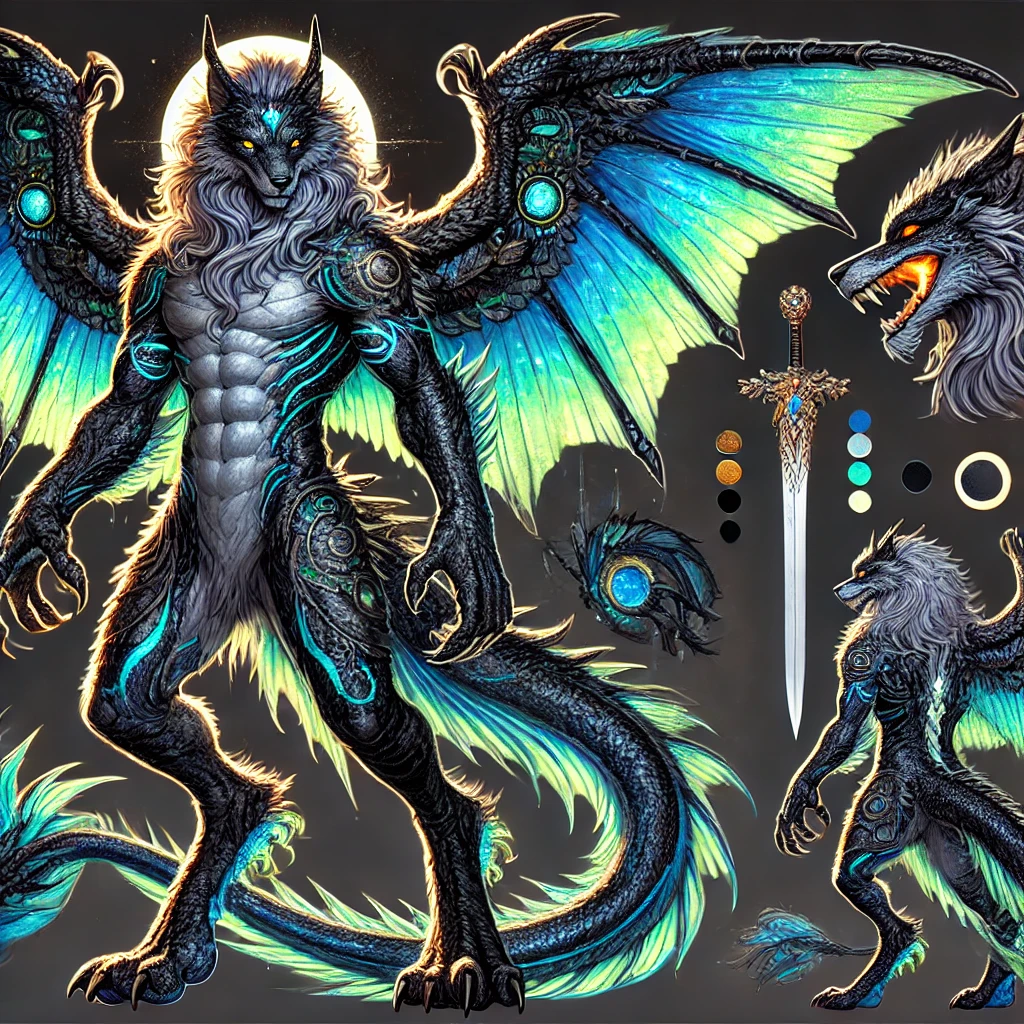
Coyote
The song dog — the great adaptor, and magic that runs to illusion.
Overview
Coyotes are the great adaptors. Their range expanded under human settlement rather than contracting, and their social structure reshapes itself around whatever the circumstances happen to be.
Their magic runs to illusion, and that inclination is the one thing the species points at.
Physical traits
Lean and rangy, built for endurance rather than force, with long limbs, a narrow muzzle and large erect ears. The tail is bushy and carried low when running, which is the reliable way to distinguish a coyote from a wolf or a domestic dog at distance.
Colouring is genuinely variable and tracks region: desert populations run pale and sandy, mountain and forest populations noticeably darker and greyer, with reddish tones common throughout. There is no single coyote coat.
They are exceptionally vocal — the “song dog” name is earned. Yips, howls, barks and group choruses carry long distances, and a small number of animals can sound like a great many.
Magic
The trickster figure attached to coyotes in folklore is not purely decorative here — it shapes what their magic tends to be. Coyote magic runs to illusion, and that inclination is the one thing the species points at.
What it does not shape is temperament. The trickster determines a register of magic and nothing about who anyone is.
Beyond illusion, magic is individual. Some coyotes carry a great deal and others very little.
Lineage
Coyotes and wolves interbreed here, exactly as the animals do in the wild.
Shared instincts
Coyotes share real instincts. Social structure shifts with circumstance — solitary when hunting small prey, paired for raising young, packed when larger prey makes cooperation worthwhile. They learn quickly, they are notably cautious around anything new, and they notice considerably more than they react to. Adaptability is genuine and it is the species’ most reliable trait.
None of that is temperament. A coyote is free to be nothing like cautious, and some are.
Where the name comes from
The coyote (Canis latrans) is a mid-sized North American canid, considerably smaller than a wolf at roughly 7–20 kg. It is one of the few large predators whose range has expanded under human settlement rather than contracting: originally a species of open western country, it now occupies the continent coast to coast, including dense urban areas.
Alongside the animal sits the trickster — a central figure across many Indigenous North American traditions, by turns creator, fool, teacher and thief. We take that seriously rather than dismissively, and it is where the illusion magic comes from. In the traditions that produced the figure, Coyote is frequently a creator and a teacher as much as a fool, and the foolishness and the wisdom are the same faculty.
Field notes
Individual colouring, size and magic belong on each member’s own page.
Shared traits
- Magic
- Illusion, drawn from the trickster figure; everything else individual
- Social structure
- Flexible — solitary, paired, or in a pack depending on circumstance
- Build
- Lean and rangy; built for endurance rather than force
- Voice
- Exceptionally vocal — the "song dog" name is earned
- Interbreeding
- With wolves, as the animals do
- Breeds
- The natural subspecies
Members
-
Kairren
A coyote whose tricks are almost always doing a job for somebody.